Most Automation Projects Don't Fail Because of the Technology
Material flow automation (moving product through receiving, storage, picking, and shipping with less manual handling) has become one of the highest-leverage investments a distribution or manufacturing operation can make. It's also one of the easier ones to get partially wrong. A conveyor line, AMR fleet, or AS/RS system can be technically sound and still underperform, not because the technology failed, but because the process underneath it was never fixed, sized, or integrated correctly.
In the 2025 MHI Annual Industry Report, supply chain leaders ranked budget constraints (41%) and an unclear cost/ROI case (40%) as the top barriers standing between them and automation investment, ahead of the technology itself. The real barrier usually isn't "does the equipment work." It's "did we plan this correctly." Below are the seven mistakes we see most often when companies automate material flow, and what to do instead.
Quick Answer
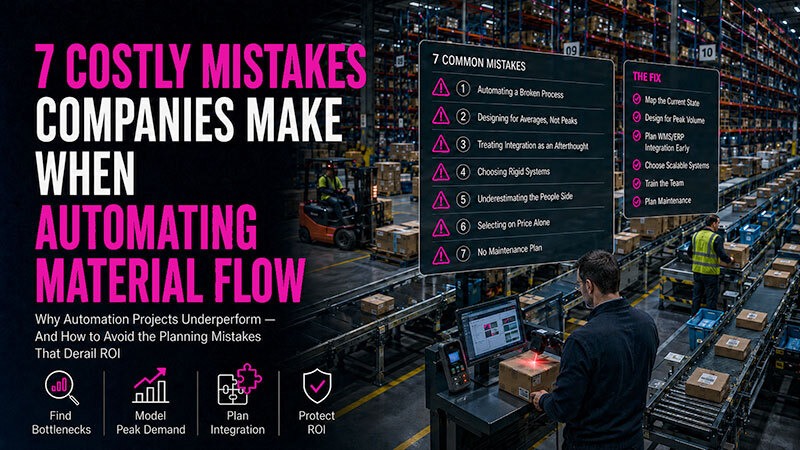
The most common mistakes are automating a broken process instead of fixing it first, sizing the system for average volume instead of peak volume, treating WMS/ERP integration as an afterthought, choosing rigid equipment over scalable systems, underestimating the training and change-management needed for staff, selecting a vendor on price alone, and skipping a plan for ongoing maintenance. Each one is a planning gap, not a technology failure, and each one is avoidable with the right assessment before equipment is purchased.
Want to avoid costly automation implementation mistakes? Talk to a Warehouse1 automation expert.
Why Material Flow Automation Projects Underperform
Automation is frequently evaluated and purchased as a technology decision, when it's really an operations decision with a technology component. When a project starts with "what should we buy" instead of "what exactly are we trying to fix," the resulting system tends to inherit every unresolved problem in the current operation, just at higher speed and higher cost.
41%
Cite budget as the top barrier to automation investment
40%
Cite an unclear ROI or business case as a barrier
43%
Average warehouse labor turnover rate industry-wide
18–60
Month ROI payback range across automation types
Sources: MHI 2025 Annual Industry Report · MHI and Deloitte, 2026 Annual Industry Report
Top Reported Challenges Facing Supply Chain & Automation Leaders
Source: MHI 2025 Annual Industry Report; Open Sky Group analysis of MHI survey data
“There is often a misconception that the technology will do all the work.” — Jeff Sierra, Founder & President, Mind Fuel
The 7 Mistakes That Derail Material Flow Automation
MISTAKE 01
Automating a Broken Process
Layout bottlenecks, inconsistent putaway logic, and undocumented workarounds don't get fixed by adding equipment. They get automated. A congested aisle becomes a congested AMR route. A manual workaround for a mislabeled SKU becomes a scanning error at machine speed. The result is a system that's faster at producing the same problems.
The Fix
Map the current-state process (throughput by hour, error rates, travel paths) before evaluating any technology. If the root issue is layout or data discipline, solve that first, even if the answer isn't automation at all.
MISTAKE 02
Designing Around Averages, Not Peaks
Aisle widths, buffer zones, and transition areas sized for a typical day quickly become chokepoints during peak volume. Order surges of 500% or more during seasonal peaks aren't unusual in distribution operations, yet many designs are built around average daily throughput rather than the busiest hour of the busiest day.
The Fix
Size transition zones, staging areas, and buffer capacity for peak volume and seasonal spikes, not steady-state averages. Ask any automation partner to model your 95th-percentile day, not just your typical one.
MISTAKE 03
Treating Software Integration as an Afterthought
Automation hardware is only as good as the software orchestrating it. When a warehouse control system, WMS, and ERP aren't planned together from the start, the result is data lag, duplicate work, and manual double-checking...exactly what automation was supposed to eliminate. This is consistently cited as one of the more expensive corrections to make after go-live.
The Fix
Bring your WMS or ERP provider into automation planning from day one, not after equipment is selected. Confirm real-time data exchange, not batch updates, between systems before signing off on a design.
MISTAKE 04
Choosing Rigid Systems Over Scalable Ones
A system sized precisely for today's SKU count and order volume can become the constraint on next year's growth. Fixed racking, single-purpose conveyor, and inflexible zoning are efficient on day one and expensive to retrofit on day 400 when the product mix, order profile, or volume shifts, which it almost always does.
The Fix
Prioritize modular, reconfigurable systems (adjustable racking, flexible AMR fleets, scalable software) over the cheapest fixed-purpose option, even at a higher upfront cost.
MISTAKE 05
Underestimating the People Side of Automation
Automation changes how people work, not just what equipment sits on the floor. When operators and supervisors are brought in late, or not trained thoroughly, utilization suffers even if the equipment performs perfectly. Idle or underused equipment because staff avoided or mistrusted it is a recurring, avoidable outcome.
The Fix
Involve floor supervisors and operators during design, not just at training week. Build new oversight and troubleshooting roles into the transition, and measure adoption, not just uptime.
MISTAKE 06
Selecting a Vendor on Price Alone
The lowest bid rarely accounts for local service response time, spare parts availability, or long-term support. When automation goes down without nearby technical support, the cost of downtime quickly outweighs whatever was saved at purchase. Out-of-region or overseas-only vendor support is a frequently cited regret among operators after a breakdown.
The Fix
Weigh total cost of ownership, service response time, and regional support availability alongside sticker price. A partner who can be on-site quickly is worth more than a marginally lower quote.
MISTAKE 07
No Plan for Maintenance or Continuous Improvement
Go-live is treated as the finish line, when it's closer to the starting point. Automated systems generate operational data (throughput, error rates, bottlenecks) that should inform ongoing tuning. Without scheduled maintenance and a habit of reviewing that data, performance quietly drifts and unplanned downtime becomes more frequent.
The Fix
Build a maintenance schedule and a data review cadence into the project from day one. Treat automation as a system to be continuously tuned, not a purchase to be checked off.
The "Broken Process, Automated" Trap
This pattern is common enough that it's worth illustrating directly. A process with an unresolved bottleneck doesn't improve when automation is layered on top of it. It typically just fails faster and in a way that's harder to diagnose.
ROI Timelines Vary by Technology. Plan Accordingly.
One reason automation budgets get rejected is a mismatch between expected and actual payback windows. Different technologies carry very different ROI curves, and pairing the wrong expectation with the wrong system is its own kind of mistake.
Median ROI Payback Period by Automation Type
Source: MHI Annual Industry Report benchmark data, as reported by Modern Materials Handling
A Simple Framework to Avoid These Mistakes
1
Document the current state first. Throughput by hour, error rates by process, travel paths, and space utilization, before any vendor conversation.
2
Define success in numbers, not adjectives. "Faster" isn't a target. "Reduce pick time by 30% at peak volume" is.
3
Design for peak, not average. Size buffers, staging, and transition zones for your busiest realistic day.
4
Bring your WMS/ERP partner in early. Integration should be part of the design conversation, not a punch-list item after install.
5
Choose flexibility over the lowest bid. Favor modular systems that can adapt to next year's SKU mix and volume.
6
Plan the people side with the same rigor as the equipment side. Training, new roles, and change management aren't optional add-ons.
7
Budget for maintenance and iteration, not just installation. The best-performing systems keep getting tuned after go-live.
Frequently Asked Questions
+ What is the most common mistake companies make when automating material flow?
The most common mistake is automating an existing process before fixing it. Layout bottlenecks, inconsistent inventory data, and undefined workflows don't disappear when robots or conveyors are added — they simply move faster and become harder to troubleshoot. Industry guidance consistently points to starting with a documented, data-backed operational assessment before selecting any technology.
+ How long does it take to see ROI from material flow automation?
Payback periods vary by technology. Benchmark data referenced in the MHI Annual Industry Report and Modern Materials Handling puts median payback for AMR-based picking systems at roughly 18–24 months, conveyor and sortation systems at 24–36 months, and automated storage and retrieval systems (AS/RS) at 36–60 months, with AS/RS often delivering the strongest lifetime ROI given its long operational life.
+ Do we need to redesign our warehouse layout before automating?
In most cases, yes, at least partially. Automated systems perform best with straight-line, single-direction flow, adequate transition zones sized for peak volume, and aisle widths and ceiling heights that match the chosen technology. Skipping this step is one of the most frequently cited causes of underperforming automation projects.
+ Can a small or mid-sized warehouse benefit from automation, or is it only for large distribution centers?
Automation scales down as well as up. Many mid-sized operations start with a targeted application, such as a single goods-to-person cell, a pick-to-light zone, or a small AMR fleet, rather than a full facility overhaul. Starting small and proving the model on one process is a widely recommended approach before scaling further.
+ What role does staff training play in a successful automation rollout?
A significant one. Automation changes how people work, not just what equipment they use. Projects that involve operators and supervisors early, invest in structured training, and create new oversight roles tend to reach full utilization faster than projects that treat change management as an afterthought.
+ How do we know if our WMS or ERP can support automation?
Confirm that your warehouse management system can exchange real-time data with the proposed automation control layer before investing in equipment. Automation that cannot integrate cleanly with existing WMS, WCS, or ERP systems tends to create manual workarounds, data lag, and traceability gaps rather than eliminating them.
Don't Let a Planning Mistake Cost You the ROI
Warehouse1's automation specialists will walk your facility, review your current material flow, and flag the risks (layout, integration, scalability) before you commit to a system, at no cost and with no obligation.
Warehouse1 has been solving material handling and warehouse automation problems since 1988. As a 100% employee-owned company based in Kansas City, Missouri, Warehouse1 acts as a single point of accountability from design through supply and installation, evaluating ASRS, vertical lift modules, robotics, automated conveyor, and pick module systems on their merits, not on which one is easiest to sell. Warehouse1 serves distribution centers, e-commerce, automotive, aerospace, and food and beverage operations, and is a member of the Material Handling Equipment Distributors Association (MHEDA).
Smarter Solutions, Not Just SKUs.Solutions designed around your operation's actual needs and goals, not a product catalog.
One Partner. End-to-End Execution.From facility assessment and layout design to installation and post-go-live support.
Easy to Work With at Every Stage.Simplifying complex projects and reducing operational disruption throughout.
Trusted Expertise. Proven Results.Decades of practical experience across the full range of material handling systems.