The Top Warehouse Bottlenecks Automation Can Eliminate
Aug 31st 2026
The Slowest Step in Your Warehouse Sets the Pace for Everything Else
Every warehouse has a slowest step. It might be a picker walking the length of three aisles for a single line item, a receiving dock stacked three trailers deep, or a peak-season rush that overwhelms a team sized for an average Tuesday. Whatever form it takes, that one constraint sets the pace for everything downstream of it, no matter how efficient the rest of the building runs.
Most warehouse bottlenecks share a common root: manual, distance-dependent work that doesn't scale with order volume. Today's automation, from conveyor and vertical lift modules to robotics and automated storage and retrieval systems (ASRS), is purpose-built to remove exactly these constraints. Below are the seven bottlenecks we see most often in distribution centers and manufacturing facilities, the data behind why they matter, and the automation systems that fix each one.
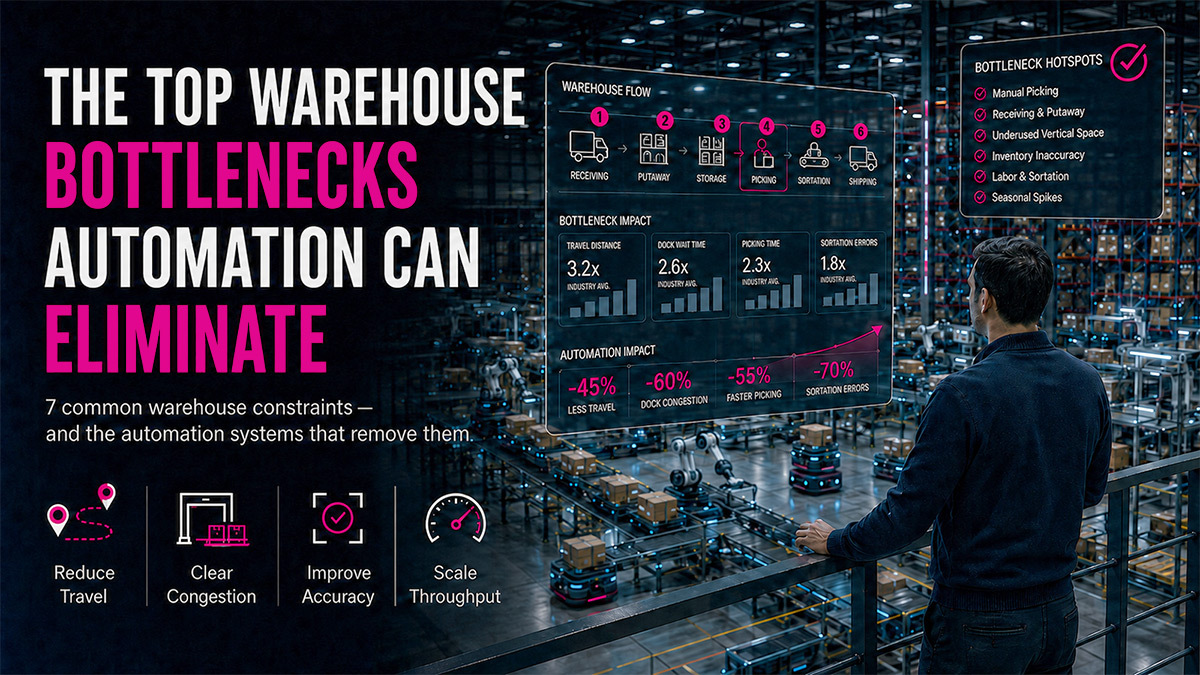
The warehouse bottlenecks automation eliminates most often are travel-heavy manual picking, congested receiving and putaway, underused vertical storage space, inventory inaccuracy, labor shortages and turnover, manual sortation errors, and seasonal volume spikes. Goods-to-person systems (VLMs, pallet shuttles), ASRS, robotics, and automated conveyor address these by moving product instead of people, using the full height of the building, and scaling output without a proportional increase in headcount.
Not sure where your biggest bottleneck is? Talk to a Warehouse1 automation expert.
Picking is typically the single largest cost center in the flow, which is why it's the highest-value place to start a bottleneck assessment.
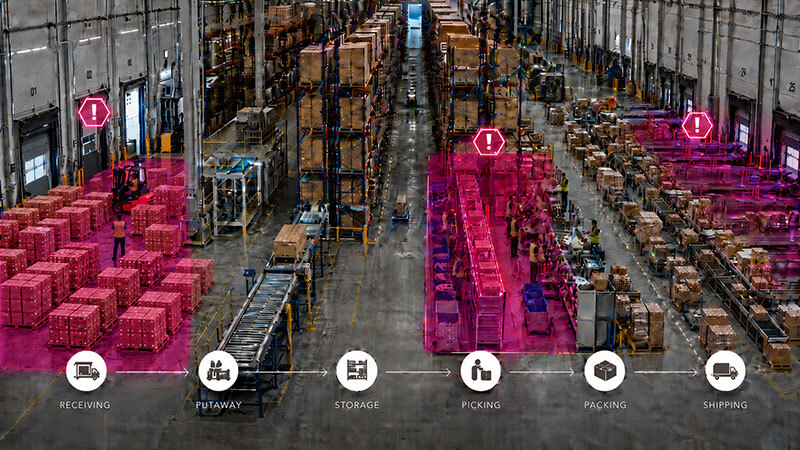
Why Bottlenecks Cost More Than They Look Like They Do
A bottleneck rarely announces itself as a single dramatic failure. More often it shows up as a slow accumulation: orders that ship a day late, overtime that becomes permanent, or a picker who quietly stops chasing quota because the travel distance makes it impossible. Order picking alone typically accounts for more than 55% of total warehouse operating cost, so even a moderate inefficiency in that single function ripples through your entire cost structure.
A stage becomes a bottleneck when required throughput exceeds that stage's practical capacity. Every stage downstream then waits on it.
Academic and industry research is consistent on where that cost hides. Research from the Georgia Tech Supply Chain and Logistics Institute found that traveling consumes about 55% of a warehouse selector's time on average, followed by paperwork and other activities at 20%, searching at 15%, and extracting product at 10%. For every hour a picker is on the clock, roughly thirty-three minutes go to walking between locations rather than picking product.
Source: Georgia Tech Supply Chain & Logistics Institute research, as reported by NetSuite (2025).
This is precisely the gap that goods-to-person automation, pick-to-light systems, and optimized routing are designed to close, by bringing inventory to the picker instead of sending the picker to the inventory.
7 Warehouse Bottlenecks Automation Can Eliminate
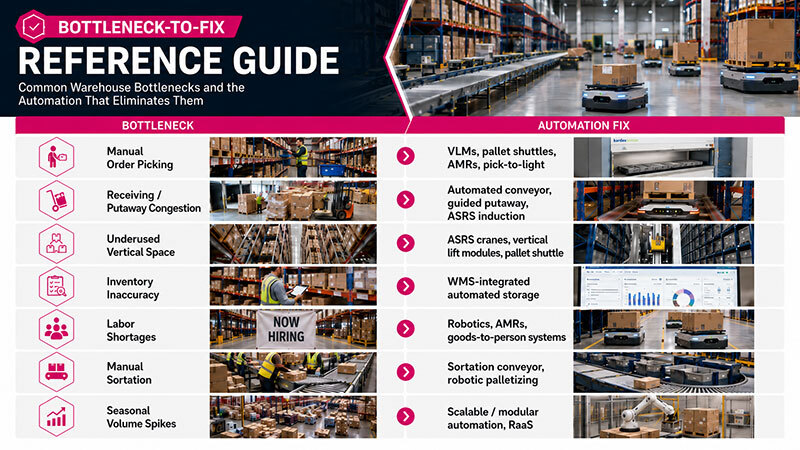
Bottleneck-to-Fix Reference Guide
| Bottleneck | Primary Symptom | Automation Solution |
|---|---|---|
| Manual order picking | Missed pick rates, picker fatigue | VLMs, pallet shuttles, AMRs, pick-to-light |
| Receiving & putaway congestion | Trailers backed up at dock | Automated conveyor, guided putaway, ASRS induction |
| Underused vertical space | High rent per unit stored | ASRS cranes, vertical lift modules, pallet shuttle |
| Inventory inaccuracy | Cycle counts, phantom stock | WMS-integrated automated storage |
| Labor shortages / turnover | Chronic open requisitions | Robotics, AMRs, goods-to-person systems |
| Manual sortation | Mis-shipped, mis-routed orders | Sortation conveyor, robotic palletizing |
| Seasonal volume spikes | Missed SLAs during peak | Scalable / modular automation, RaaS |
How to Identify Your Warehouse's Bottlenecks
Before investing in any automation system, it's worth mapping exactly where your operation loses time. A structured facility and workflow assessment typically looks at:
- Travel distance and cycle time at each stage of the pick, pack, and ship process.
- Storage utilization, including whether you're using the full clear height of the building.
- Order accuracy and error rate by function, to isolate where mistakes originate.
- Labor allocation, comparing headcount against repetitive, high-travel, or physically demanding tasks.
- Peak-to-baseline volume swings and whether current staffing and equipment can absorb them.
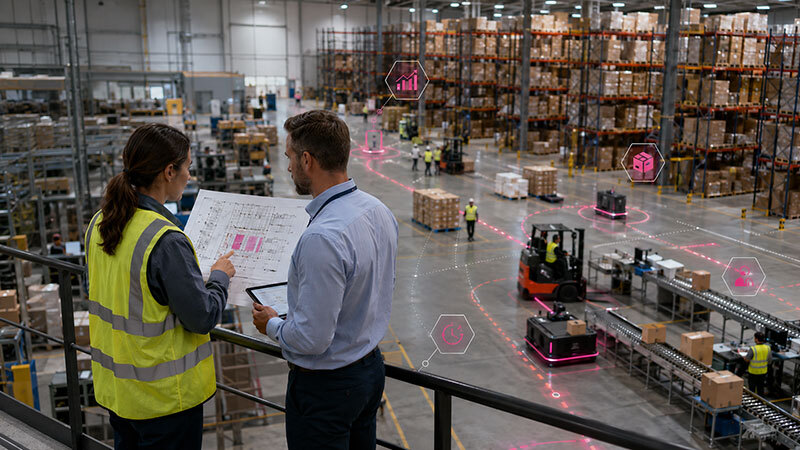
This is exactly the process Warehouse1 walks through with clients during a facility survey and layout design consult: identifying which constraint is actually limiting throughput, then matching it to the right mix of ASRS, robotics, conveyor, or racking solution, rather than automating for its own sake. It's also fine, and often smart, to pilot automation in one zone before expanding to the rest of the facility.
Frequently Asked Questions
Not Sure Which Bottleneck to Tackle First?
Warehouse1's automation experts will help you map your workflow, pinpoint the constraint actually limiting your throughput, and build a phased plan, ASRS, robotics, conveyor, or racking, to fix it.
About Warehouse1
Warehouse1 has been solving material handling and warehouse automation problems since 1988. As a 100% employee-owned company based in Kansas City, Missouri, Warehouse1 acts as a single point of accountability from design through supply and installation, evaluating ASRS, vertical lift modules, robotics, automated conveyor, and pick module systems on their merits, not on which one is easiest to sell. Warehouse1 serves distribution centers, e-commerce, automotive, aerospace, and food and beverage operations, and is a member of the Material Handling Equipment Distributors Association (MHEDA).
| Smarter Solutions, Not Just SKUs. Solutions designed around your operation's actual needs and goals, not a product catalog. | One Partner. End-to-End Execution. From facility assessment and layout design to installation and post-go-live support. |
| Easy to Work With at Every Stage. Simplifying complex projects and reducing operational disruption throughout. | Trusted Expertise. Proven Results. Decades of practical experience across the full range of material handling systems. |
Sources & Further Reading
Georgia Tech Supply Chain & Logistics Institute research, as cited in NetSuite, "55 Expert Warehouse Order Picking Tips and Best Practices"
MHI, "AI and Robotics: Powering the Next Generation of Supply Chains," MHI Blog, 2026, citing the MHI Annual Industry Report
Keith Moore, CEO, AutoScheduler.AI, quoted in "AutoScheduler.AI Exhibits AI-Enhanced Warehouse Orchestration at ProMat 2025", GlobeNewswire, February 2025
SellersCommerce, "Warehouse Automation Statistics (2026)", citing U.S. Bureau of Labor Statistics and Descartes Systems Group research
de Koster, Zhang, et al., "Trends in Order Picking: A 2007–2022 Review of the Literature," Taylor & Francis, 2023