Pallet Rack Dimensions Guide: Sizes, Depths & Clearances
Aug 18th 2026
The Four Numbers Every Rack Order Comes Down To, and How They Fit Your Pallets, Forklifts, and Building
A pallet rack quote looks simple until it isn't. Somewhere between the sales drawing and the steel showing up on the dock, a pallet rack upright's depth gets rounded to the nearest standard size, a beam length gets chosen because it was in stock, and an aisle width gets set before anyone confirms which forklift is actually going to run it. Months later, pallets are barely fitting on the beams, a reach truck can't complete its turn in the aisle, or the rated capacity on the load plaque is lower than what the product actually weighs.
None of that is inevitable. Pallet rack dimensions follow a fairly small set of standard sizes, and once you understand how upright depth, beam length, upright height, and beam spacing relate to your pallet, your forklift and your building, sizing a layout stops being guesswork. This guide walks through the standard dimensions used in selective pallet rack today, where those numbers come from, and where a size chart has to give way to an engineered drawing.
Most selective pallet rack sold in North America uses 42-inch-deep upright frames, beams ranging from 96 to 144 inches long, and uprights manufactured in 2-foot height increments from 8 to 30-plus feet. The 42-inch upright depth is sized for a standard 48-inch-deep GMA pallet, leaving a 3-inch overhang on the front and back of the beam, and a 96-inch beam holds two 40-inch-wide pallets per level. Aisle width then depends on your lift truck, from roughly 12 to 13 feet for sit-down counterbalance trucks down to 5 to 7 feet for very narrow aisle turret trucks. Treat these as planning benchmarks rather than final specifications, since your rack supplier's engineered layout and load plaques determine the actual rated capacity for your facility.
The Four Numbers That Define Every Rack Bay
Every selective pallet rack bay, regardless of manufacturer, comes down to four dimensions. Get comfortable with these four and every rack quote, drawing and load plaque you look at from here on will make a lot more sense.
|
1
Upright Depth How far the upright frame extends front to back, sized to your pallet with room for overhang. |
2
Beam Length The inside horizontal span between uprights, sized to how many pallets sit across one level. |
|
3
Upright Height How tall the upright frame is, driven by ceiling height, forklift reach and sprinkler clearance. |
4
Beam Level Spacing The vertical gap between beam levels, driven by your tallest loaded pallet plus clearance. |
The diagram below shows how those four numbers actually show up on a selective rack bay.
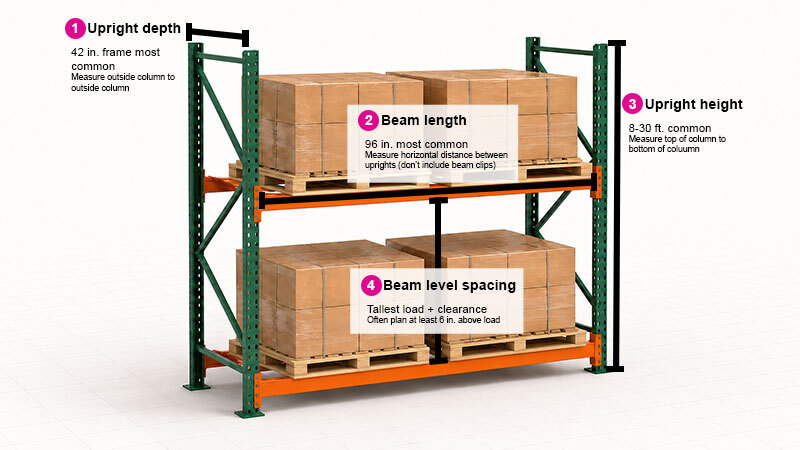
Diagram: common selective rack configurations. Actual dimensions vary by manufacturer and load; confirm with an engineered rack drawing before ordering.
Standard Upright (Frame) Depths
Upright depth, also called frame depth, is measured from the front edge of the front column to the back edge of the back column. It's one of the few rack dimensions that should almost never be guessed, because it's a direct function of the pallet sitting on it. The convention used across the industry is to leave a 3″ overhang on the front and back of the beam so the pallet's full weight transfers onto the beam face rather than hanging past it, which is why upright depth typically runs about six inches shallower than the pallet itself.
(a 3″ overhang on the front and back of the beam)
| Upright Depth | Sized For | Notes |
|---|---|---|
| 24″–30″ | Hand-stacked cartons, small parts | Light-duty, non-palletized or narrow-footprint loads |
| 36″ | 42″ pallets | Smaller footprints or tighter building spans |
| 42″ | 48″ pallets (GMA standard) | The most common depth in North American distribution centers |
| 48″ | 54″+ pallets, oversized loads | Deeper industrial, automotive or specialty loads |
Standard Beam Lengths and Pallets Per Level
Beam length is measured from the inside face of one upright frame to the inside face of the other, since that inside dimension is what actually carries the pallet. Standard selective rack beams are typically sold in one-foot increments, and a 96″ beam is by far the most common length in North American warehouses because it holds two 40-inch-wide GMA pallets per level with enough side clearance to load and unload safely.
| Beam Length | Pallets per Level* | Typical Use |
|---|---|---|
| 48″ (4 ft) | 1 | Hand-stack and narrow-SKU bays |
| 96″ (8 ft) | 2 | The most common selective rack bay in North America |
| 108″ (9 ft) | 2 (extra clearance) | Thicker pallets, taller loads, high-turn pick faces |
| 120″ (10 ft) | 2 | Extra hand clearance for irregular loads |
| 144″ (12 ft) | 3 | Bulk storage with fewer uprights per row |
*Based on a 40″-wide GMA pallet oriented across the beam. Confirm against your actual pallet footprint before ordering.
Upright Height and Beam Level Spacing
Upright height is typically manufactured in two-foot increments, from around 8 feet up to 30 feet or more for high-bay applications. It's tempting to size the upright to the ceiling and stop there, but the number that actually matters is your clear ceiling height, the distance from the floor to the lowest hanging obstruction, whether that's a sprinkler deflector, HVAC duct, or roof truss, combined with how high your forklift can actually lift and place a pallet.
Beam level spacing works the same way in miniature: the clear height between one beam and the beam above it needs to fit your tallest loaded pallet plus enough room for a forklift operator to place and retrieve it without striking the beam above. Most rack suppliers plan for a working clearance of several inches above the tallest load at each level, and facilities with fire sprinklers need to keep at least 18″ of clearance below sprinkler deflectors under OSHA's fire protection standard, which often ends up being the real ceiling on how tall a top-loaded level can go.
Clearances That Actually Matter
Dimensions on a spec sheet only tell part of the story. The clearances built into and around a rack row are what keep a layout safe to operate day to day, and they're the numbers most often shortchanged when a warehouse is trying to squeeze in one more bay.
|
42″
Most common upright depth, sized for 48″ pallets
|
96″–144″
Standard beam length range
|
|
3″
Standard overhang on each side of the beam
|
18″
OSHA-required clearance below sprinkler deflectors
|
Sources: OSHA 29 CFR 1910.159(c)(10), Automatic Sprinkler Systems; common selective rack upright and beam conventions cross-referenced across manufacturer specifications.
OSHA doesn't spell out an exact number for beam-to-load clearance or side-to-side pallet spacing, but it does require, under its general materials handling standard, that mechanical handling equipment be given sufficient safe clearance in aisles, at loading docks and wherever turns must be made. That general requirement is what makes aisle width, the next dimension, so dependent on the specific truck running it.
Aisle Width by Lift Truck Type
Aisle width is the one pallet rack dimension that has nothing to do with the rack itself. It's set entirely by the turning geometry of whatever lift truck has to work that aisle, and the range across truck types is enormous, from a sit-down counterbalance truck that needs a wide, unobstructed turning radius, down to a very narrow aisle turret truck that never turns in the aisle at all.
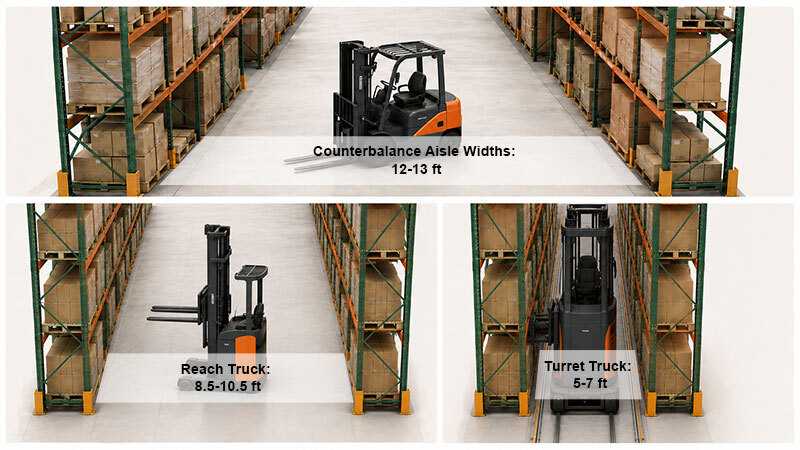
Source: Toyota Material Handling, "Narrow Aisle Forklifts: Space-Saving Solutions." Figures are general ranges; always confirm the right-angle stack specification against your specific truck model.
Switching from a 12-foot conventional aisle to a 9-foot reach truck aisle, or further down to a 6-foot VNA aisle, adds meaningful pallet positions to the same building footprint, which is why aisle width is usually the first thing a warehouse automation conversation turns to once upright depth and beam length are settled. It's also why guidance systems, wire or rail, become standard equipment once aisles narrow below about 7 feet: the truck simply can't rely on operator steering alone at that clearance.
Matching Rack Depth to Your Pallet
Nearly every standard rack dimension in this guide traces back to a single pallet footprint: the 48-inch by 40-inch GMA pallet, named for the Grocery Manufacturers Association standard that popularized it decades ago and still maintained today through the National Wooden Pallet & Container Association's uniform pallet standard. That single footprint is why 42-inch upright depth and 96-inch beam length became the default combination in so many North American distribution centers: it's the depth and length that best fit a 48x40 pallet with proper overhang, whether it's turned 48 inches deep into the rack or 40 inches wide across the beam.
If your operation runs a different pallet, 42x42 chemical pallets, 48x45 automotive pallets, or 48x48 for bulkier goods, the same overhang logic still applies, it just produces a different upright depth. This is exactly the kind of detail worth confirming with actual pallet measurements before a rack order goes in, rather than assuming the GMA standard applies by default.
What Governs These Numbers: ANSI MH16.1 and OSHA
Everything covered so far is a planning benchmark, the sizes you'll see most often and the logic behind them. The dimensions that actually matter for a permit, an insurance file or a safety inspection come from ANSI MH16.1, the design and engineering standard for industrial steel storage rack published by the Rack Manufacturers Institute, a division of MHI. That standard doesn't just define beam and upright sizes; it sets the structural design factors, including seismic and stability requirements, that determine how much weight a given configuration can actually hold, and its most recent revision expanded those calculations from a single factor to nine, specific to each installation's connectors, column stiffness and loading pattern.
OSHA doesn't publish its own rack sizing standard, but its general materials handling regulation requires that storage be arranged so it doesn't create a hazard and that mechanical equipment be given sufficient safe clearance to operate. In practice, that means the rated capacity posted on your rack's load plaque and the layout confirmed in its rack configuration drawing carry real regulatory weight, and reconfiguring beam elevations without updating either one is one of the more common gaps inspectors find.
Common Pallet Rack Dimensioning Mistakes
Estimate Your Rack Row Footprint
Use the calculator below for a rough, planning-stage estimate of how much floor space a row of selective rack will take up, aisle included, and roughly how many pallet positions it holds. It's a starting point for a conversation, not a substitute for an engineered layout.
Get Your Rack Dimensions Right the First Time
Warehouse1's design team will measure your pallets, model your building and confirm the upright depth, beam length, upright height and aisle width your operation actually needs, before steel goes on order.
About Warehouse1
Warehouse1 has been solving material handling and warehouse automation problems since 1988. As a 100% employee-owned company based in Kansas City, Missouri, Warehouse1 acts as a single point of accountability from design through supply and installation, evaluating ASRS, vertical lift modules, robotics, automated conveyor, and pick module systems on their merits, not on which one is easiest to sell. Warehouse1 serves distribution centers, e-commerce, automotive, aerospace, and food and beverage operations, and is a member of the Material Handling Equipment Distributors Association (MHEDA).
| Smarter Solutions, Not Just SKUs. Solutions designed around your operation's actual needs and goals, not a product catalog. | One Partner. End-to-End Execution. From facility assessment and layout design to installation and post-go-live support. |
| Easy to Work With at Every Stage. Simplifying complex projects and reducing operational disruption throughout. | Trusted Expertise. Proven Results. Decades of practical experience across the full range of material handling systems. |
Sources & Further Reading
OSHA 29 CFR 1910.176, Handling Materials, General
OSHA 29 CFR 1910.159, Automatic Sprinkler Systems
National Wooden Pallet & Container Association, Uniform Standard for Wood Pallets
Modern Materials Handling, "Getting Warehouse Rack Systems Right"
Toyota Material Handling, "Narrow Aisle Forklifts: Space-Saving Solutions"