10 Signs Your Warehouse Is Ready for Automation
Jun 19th 2026
When Is a Warehouse Ready for Automation? 10 Signs to Look For
Hiring isn't getting easier, order volume isn't slowing down, and "just add more people" stopped being a real plan a while ago. Here's how to tell whether your facility is actually ready to automate — and what's still missing if it isn't.
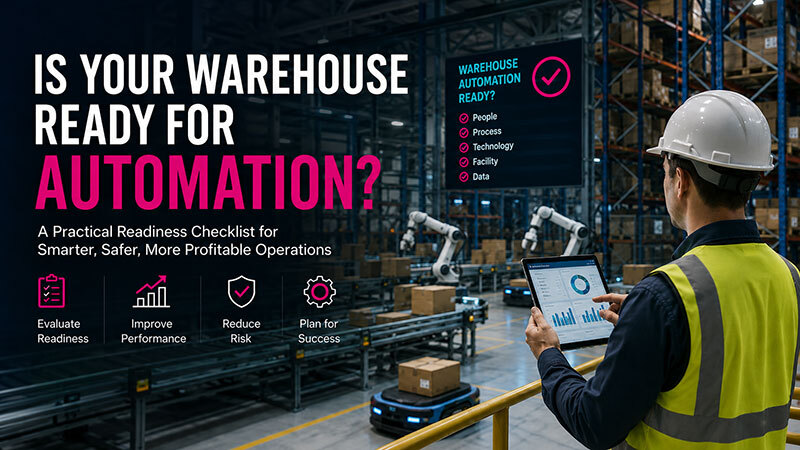
For most of the last few decades, the answer to "we need more throughput" was "hire more people." That math has quietly stopped working. Warehouse operators are fighting a labor market that won't cooperate, an e-commerce customer base that wants more, smaller, faster orders, and accuracy and safety expectations that keep climbing — all while floor space stays exactly the same size it was when the building was built.
The risk runs in both directions. Move too early, before your building, data, or team can support the technology, and you'll spend capital on a system that underperforms. Wait too long, and competitors with better cost structures start winning business you used to take for granted, while your current team burns out trying to keep up manually. Most of the hesitation in between comes down to uncertainty: nearly two in five operators point to budget as their top automation barrier, and almost as many cite an unclear ROI case (MHI, 2025 Annual Industry Report) — not the technology itself.
This guide replaces that guesswork with a framework. The ten signs below split into three categories: operational pressure (the pain pushing you toward automation), technical and financial capability (whether your building, data, and budget can support it), and organizational execution (whether your people and plan can carry it through). Run through all ten, and you'll have a clear, evidence-based read on where your operation actually stands.
The 10 Signs at a Glance
Think of this like a tape measure for your operation. The first five ticks capture operational pressure, the next three measure technical and financial capability, and the last two gauge organizational execution. Click any sign below to jump straight to it.
Operational Pressure: The Pain Pushing You Toward Automation
These five signs describe the day-to-day friction that usually starts the automation conversation in the first place — the problems hiring more people can no longer solve.
If your biggest planning variable every quarter is "can we staff this," that's the clearest single signal on this list. Warehouse operators rate hiring as extremely challenging at a 52% clip, and retention isn't far behind at 45% (MHI, 2025 Annual Industry Report). Layer on annual warehouse-worker turnover that industry analyses peg around 36% based on Bureau of Labor Statistics data, plus a national shortfall of more than 400,000 unfilled warehousing and storage positions, and the math behind "just hire more" stops working — fully loaded labor cost, once overtime, agency markups, and constant retraining are counted, typically runs 1.3 to 1.5 times base wage.
Sources: MHI, 2025 Annual Industry Report; Zebra Technologies, Warehousing Vision Study; Bureau of Labor Statistics-derived industry analysis.
E-commerce hasn't just grown — it's grown into a fundamentally different kind of work. Pallet-in, pallet-out operations are forgiving of manual processes. Fragmented, single-and-few-unit e-commerce orders are not. In Q1 2026, e-commerce reached 16.9% of total U.S. retail sales on a seasonally adjusted basis, up 9.8% year over year — more than double the 3.9% growth rate of retail overall (U.S. Census Bureau, Quarterly E-Commerce Report). Meanwhile, 43% of operators name faster delivery expectations from customers as a top operational challenge (MHI, 2025). Adding headcount to handle more, smaller, more fragmented orders eventually hits a wall; automated picking, sortation, and conveyance scale in a way linear headcount additions can't.
Source: U.S. Census Bureau, Quarterly Retail E-Commerce Sales.
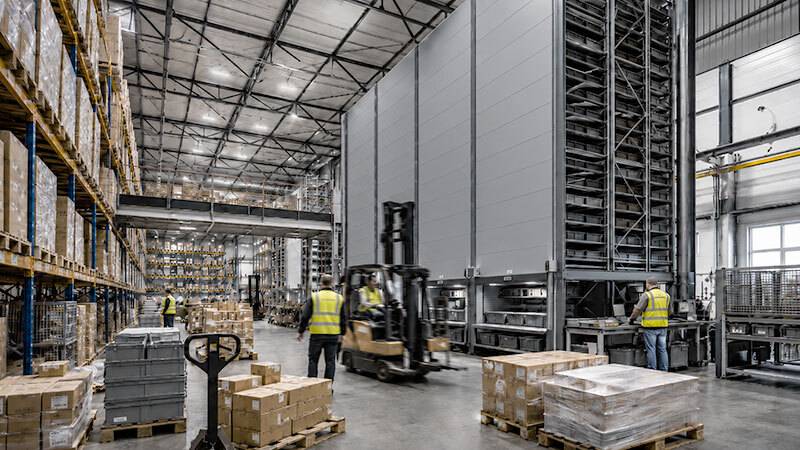
Leasing more square footage or breaking ground on an expansion is slow, expensive, and often not even available in your market. That's a structural problem: global warehouse footprint is projected to grow 27% by 2030 — from roughly 3.06 billion to 3.9 billion square meters — while warehouse labor spend is projected to grow at a 7% compound annual rate over the same period (Interact Analysis). When you can't go wider, the only lever left is going taller. That's precisely the value proposition behind automated storage and retrieval systems (ASRS) and vertical lift modules — they multiply storage density within your existing building footprint instead of requiring more land.
Picking errors don't stay contained to the warehouse — they show up downstream as returns, chargebacks, and customer churn. Manual and legacy picking operations typically run in the 95–98% accuracy range, while best-in-class automated picking operations land at 99.5–99.9%, according to converging industry benchmarking. More than a third of warehouses report error rates of 1% or higher. That gap compounds at scale: 51% of decision-makers say they struggle to meet fill rates, and 47% struggle with order accuracy or prep (Zebra Technologies, Warehousing Vision Study).
Manual range 95–98%, automated range 99.5–99.9%: converging industry benchmarking sources. Decision-maker struggle rates: Zebra Technologies, Warehousing Vision Study.
Warehousing and storage carries a recordable injury rate of 4.8 per 100 full-time workers — more than double the 2.3 average across all private industry (U.S. Bureau of Labor Statistics). Forklift-related incidents alone cause an estimated 35,000 to 62,000 injuries each year nationally, with roughly 70% considered preventable through better training and engineering controls, and about a quarter of all warehouse accidents occurring at loading docks (OSHA; National Safety Council). It's not an abstract risk to your team either: 70% of warehouse associates say they're personally concerned about getting injured on the job (Zebra Technologies). Automating the most repetitive, high-risk movements — heavy lifting, repetitive travel through forklift traffic, sustained reaching — is one of the few levers that improves both safety and throughput at the same time.
Source: U.S. Bureau of Labor Statistics; forklift and dock-accident figures: OSHA and National Safety Council.
Technical & Financial Capability: Can Your Building, Data, and Budget Support It?
Feeling the pressure above is necessary but not sufficient. These three signs determine whether you can actually act on it.
This is the first hard filter, and it has nothing to do with budget. Most existing buildings were built around people and forklifts moving through aisles — not around the precision and load requirements of automated equipment.
The 6 Universal First-Filter Variables
Six variables act as the universal first filter for almost any warehouse automation project:
|
Clear Height
The usable vertical space from floor to the lowest obstruction — including sprinklers, beams, and lighting.
|
Floor Flatness & Load Rating
Slab flatness and PSI load capacity that automated equipment is rated for.
|
|
Column Spacing & Aisle Width
Bay spacing and aisle dimensions determine which automation layouts will fit.
|
Power Capacity
Electrical infrastructure sized for motors, controls, and charging systems.
|
|
Fire Protection Design
Sprinkler and suppression systems specified for your planned storage height and configuration.
|
Dock & Yard Flow
How trucks, trailers, and inbound/outbound flow connect to the automated zone.
|
A facility survey — measuring all six before equipment is selected — is the single most important step in any automation project, and it's also one most operators skip in favor of jumping straight to vendor quotes. Older buildings aren't automatically disqualified, either: condition and dimensions matter far more than the age on the deed.
Source: Prologis, Building Readiness for Automation.
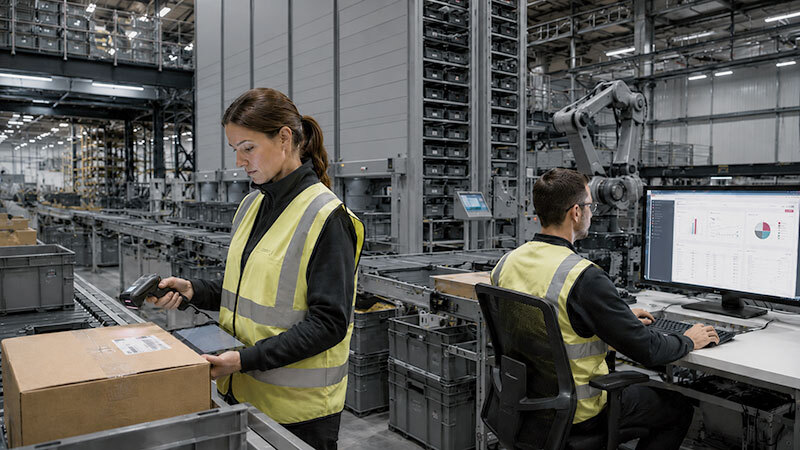
Automation amplifies whatever you feed it — including bad data. A person who finds an inventory record is wrong will usually notice something's off and pause. A robot won't. It will execute incorrect location or quantity data with complete confidence, and it'll do it far faster than a human ever could, which means errors compound instead of getting caught. Before any equipment gets selected, it's worth taking an honest look at WMS and ERP accuracy, barcode or RFID discipline, and how clean your SKU and location data really is. Most automated systems also need a warehouse control system (WCS) to bridge your WMS to the physical hardware — and that integration needs to be mapped out before equipment selection, not after.
This is where most automation projects actually stall — not on the technology, but on the business case. Budget constraints (41%) and a lack of clarity on cost and ROI (40%) are the two most commonly cited barriers to automation adoption (MHI, 2025 Annual Industry Report).
The market backdrop supports urgency without supporting hype. The global warehouse automation market is projected to grow from roughly $30 billion in 2023 to $69 billion by 2030, a 12.7% compound annual growth rate (MHI, 2024 Annual Industry Report), and 39% of supply chain leaders now rate robotics and automation as having a significant or greater disruptive impact — up 16 percentage points year over year (MHI/Deloitte, 2026).
But sentiment is running ahead of deployment: actual North American robot installations grew just 0.5% in 2024 even as enthusiasm climbed (Association for Advancing Automation). That gap is exactly why a disciplined, well-documented ROI case — not conviction alone — is what actually gets projects approved and funded.
Source: MHI, 2024 Annual Industry Report (via Modern Materials Handling); installation-growth figure: Association for Advancing Automation (A3).
Organizational Execution: Are Your People and Plan Ready?
Even a perfect facility and a bulletproof ROI case fail without the right people and rollout plan behind them.
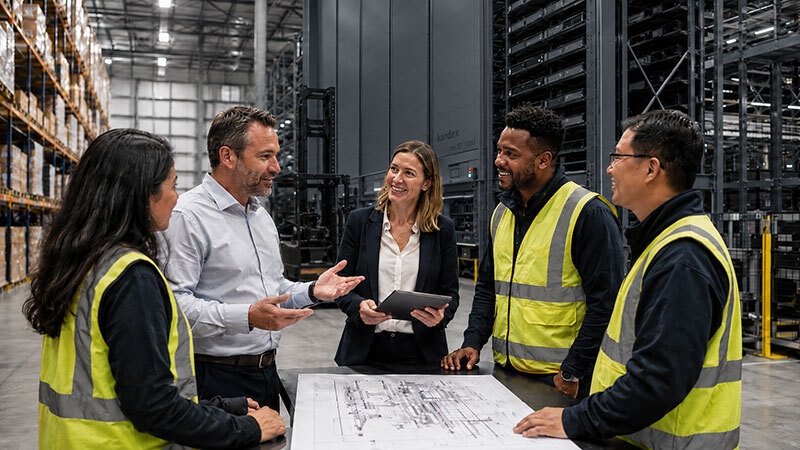
Automation projects rarely fail on the equipment. They fail when the rollout gets imposed top-down with no warning, training is rushed, and the frontline team treats the new system as something being done to them rather than with them. Effective change management means aligning the organization at every level, not just the C-suite — appointing a dedicated change-management lead, empowering middle managers and frontline supervisors as champions, and choosing an implementation partner who treats your team as part of the rollout plan (SupplyChainBrain). As one trade publication puts it, an automation transition is fundamentally a culture shift, not just an equipment install (Plant Engineering). The payoff for getting this right is real: 86% of decision-makers who involve associates directly in automation decisions report it improves both attraction and retention of warehouse talent (Zebra Technologies).
Piloting one zone or process before going facility-wide isn't a sign of caution — it's the strategy that consistently works. A phased approach reduces capital risk, lets your team build real comfort with the technology at a manageable scale, and generates operating data that improves every phase that follows.
It's also where the difference between a distributor and a true systems integrator becomes obvious. Coverage in trade publications on the shift from distribution to integration highlights that integrators provide facility design, feasibility studies, and simulation work up front — and then stay engaged after go-live with 24/7 troubleshooting, remote diagnostics, and spare-parts planning, which typically runs 3–5% of total project cost (MHEDA Journal). With automated systems built for 20-plus-year lifespans, who you choose as a long-term partner matters as much as which equipment you choose — regardless of which brand ends up on the floor.
Count Your Signs: A 60-Second Self-Check
Check every box that's true for your operation right now.
There's no perfect score — this is a quick gut-check, not a diagnosis.
Frequently Asked Questions
Q. How do I know if my warehouse is ready for automation?
A. There is no single test, but readiness usually comes down to three things: operational pressure, physical and financial capability, and organizational execution. If labor, volume, space, accuracy, or safety problems can no longer be solved by simply adding people, and your building, data, and leadership team can support a structured rollout, it may be time for a warehouse automation readiness assessment.
Q. What is the difference between a material handling distributor and a systems integrator?
A. A material handling distributor typically sells equipment such as pallet rack, shelving, conveyor components, and storage products. A systems integrator helps design and support a complete solution, including facility surveys, layout design, equipment selection, installation, controls, integration planning, and long-term support after go-live.
Q. How much does warehouse automation typically cost?
A. Costs vary widely depending on the scope of the project. A targeted conveyor zone, vertical lift module, or focused automation project may cost far less than a full-facility AS/RS, robotics, or goods-to-person system. The best first step is a facility assessment and throughput review so the solution is sized to the actual problem.
Q. What is a realistic payback period for warehouse automation?
A. Many warehouse automation projects are evaluated on a two- to five-year payback window, but the real answer depends on labor savings, throughput gains, accuracy improvements, safety impact, space utilization, and the total cost of the system. The basic formula is: payback period equals total capital investment divided by annual net benefit.
Q. Can I automate just one part of my warehouse?
A. Yes. In many cases, starting with one zone or process is the smartest approach. A phased rollout can reduce capital risk, help employees adjust to new workflows, and create real operating data that improves future phases. Common starting points include picking, sortation, packing, pallet movement, replenishment, or high-density storage.
Q. Can older or smaller warehouse buildings be retrofitted for automation?
A. Often, yes. A building’s age matters less than its current condition and dimensions. Important factors include clear height, floor flatness and load rating, slab condition, column spacing, aisle width, electrical capacity, fire protection design, dock access, and available staging space.
Q. What happens during a warehouse automation readiness assessment?
A. A readiness assessment typically reviews the physical building, current material flow, order and inventory data, labor metrics, throughput requirements, safety concerns, software systems, and business goals. The goal is to identify where automation makes sense, where it does not, and what should happen before any major investment is made.
Q. How long does a warehouse automation project take from planning to go-live?
A. Timeline depends on project complexity. A targeted project may move from assessment to go-live in a few months. Larger systems such as AS/RS, goods-to-person automation, robotics, or multi-zone conveyor systems can take longer because they require engineering, equipment lead times, installation, testing, training, and integration planning.
About Warehouse1
Warehouse1 has been solving material handling and warehouse automation problems since 1988. As a 100% employee-owned company based in Kansas City, Missouri, Warehouse1 acts as a single point of accountability across the entire project lifecycle: facility surveys, layout design, equipment selection across leading automation manufacturers, installation, and ongoing project management — all from 1 source. Warehouse1 serves operations across automotive, distribution, food and beverage, manufacturing, government, healthcare, and other industries, and is a member of the Material Handling Equipment Distributors Association (MHEDA).
Sources & Further Reading
- MHI, Annual Industry Report (2024–2026 editions)
- U.S. Census Bureau, Quarterly Retail E-Commerce Sales
- U.S. Bureau of Labor Statistics
- Occupational Safety and Health Administration (OSHA)
- National Safety Council
- National Fire Protection Association (NFPA)
- Zebra Technologies, Warehousing Vision Study
- Modern Materials Handling
- DC Velocity
- MHEDA & MHEDA Journal
- Prologis
- Interact Analysis
- Association for Advancing Automation (A3)