
Automation and Intralogistics: What's Real and What's Hype?
Aug 4th 2026
Separating Proven ROI From Vendor Hype in Today's Warehouse Automation Market
Right now trade show keynotes, LinkedIn posts, and vendor pitch decks carry a similar message: the fully autonomous, human-optional warehouse is right around the corner. Meanwhile, the operators actually running distribution centers are asking a more practical question — what should I actually invest in this year? This article separates the intralogistics technologies with a real, documented track record from the claims that are still ahead of the deployment data.
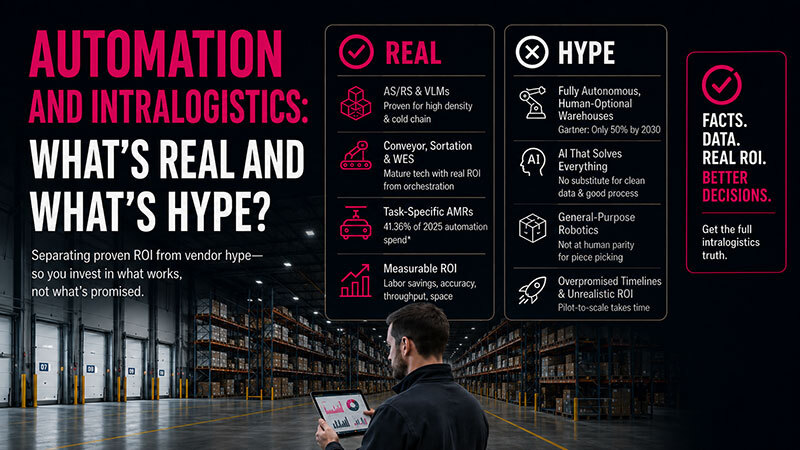
The warehouse automation market is genuinely growing but that growth concentrates in a handful of proven categories: AS/RS, conveyor and sortation, warehouse execution software, and task-specific AMRs. What's still ahead of the evidence is the fully "lights-out," human-optional facility and general-purpose robotic piece-picking at human parity: Gartner projects only half of new developed-market warehouses will be human-optional by 2030, and even then expects just 1 in 20 supply chain managers to be managing robots instead of people. The practical takeaway: automate the specific bottleneck you actually have, not the vision on a vendor's roadmap slide.
The State of the Market
Start with the headline numbers, because they tell two true stories at once. Mordor Intelligence puts the global warehouse automation market at $34.17B in 2026, growing at a 13.98% compound annual rate to reach $65.74B by 2031. Autonomous mobile robots alone captured 41.36% of 2025 automation spending, and piece-picking robotics is forecast to grow at a 15.27% CAGR as improved vision and gripping systems handle a wider range of SKUs. That is not hype — that is capital actually being committed, year over year.
The second story is the adoption gap. A Modern Materials Handling review of a November 2025 DHL Supply Chain survey found that 44% of participants had deployed some form of warehouse robotics — but only 34% of VP- and Director-level executives said they were fully satisfied with the results. That gap between "we did it" and "it's working the way we hoped" is the clearest evidence that automation adoption and automation value are two different things, and that most of the difference comes down to integration and change management rather than the underlying hardware.
|
$65.74B
Projected global warehouse automation market size by 2031, up from $34.17B in 2026
Source: Mordor Intelligence, 2026
|
41.36%
Share of 2025 warehouse automation spending captured by autonomous mobile robots
Source: Mordor Intelligence, 2026
|
|
44%
Warehouse operators who have deployed some form of robotics
Source: DHL Supply Chain Survey via Modern Materials Handling, Nov. 2025
|
34%
VP/Director-level executives fully satisfied with their robotics results
Source: DHL Supply Chain Survey via Modern Materials Handling, Nov. 2025
|
Put those together and the honest read is this: automation adoption is real and accelerating, but satisfaction hasn't caught up with deployment. If your facility hasn't automated yet, you're not behind — you're in a position to learn from the roughly two-thirds of VP/Director-level leaders who say their existing automation isn't fully delivering, and plan accordingly.
What's Real Today
These are the categories of intralogistics technology with years of installed base, published performance data, and repeatable ROI models across food and beverage, manufacturing, distribution, and 3PL operations.
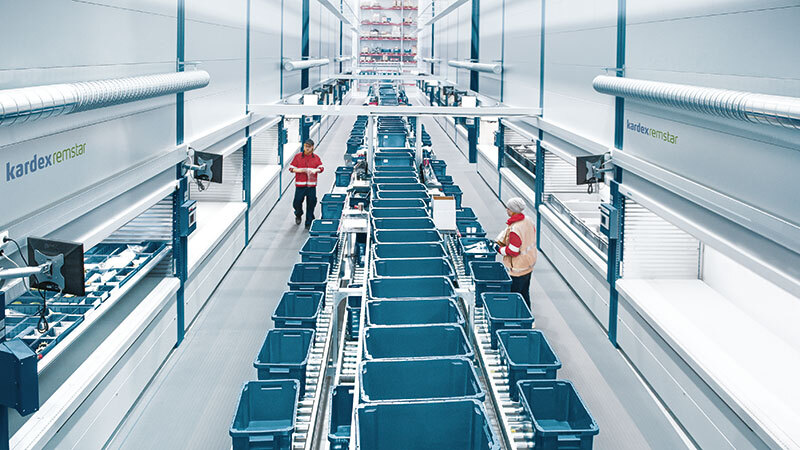
Automated Storage and Retrieval Systems (AS/RS). Vertical Lift Modules and pallet shuttle systems remain the backbone of temperature-sensitive and high-density operations. Mordor Intelligence notes that AS/RS retains a stronghold in cold-chain sites where ±2°C accuracy is mandatory, while conveyor and sortation equipment dominates parcel hubs running 10,000-plus units per hour. This is mature, engineered equipment with decades of installed base, not experimental robotics.
Conveyor, Sortation, and Warehouse Execution Software. Conveyor and automated sortation have been core to distribution for decades. What's changed is the software layer riding on top of it: Warehouse Execution Systems now orchestrate workload dynamically across human labor and robotic fleets, and a growing share of the real ROI in mature facilities is coming from that orchestration layer rather than from adding more hardware.
Task-Specific AMRs via Robotics-as-a-Service. Autonomous Mobile Robots that move totes, carts, or goods-to-person shelving in a bounded, well-mapped workflow captured 41.36% of 2025 automation spending — the single largest category by dollars. Robotics-as-a-Service contracts, which swap a large capital purchase for a usage-based subscription, are helping mid-sized operators access this technology without committing to a full outright purchase up front.
Full-Facility Automation at Commercial Scale. Full-DC automation platforms have also cleared a real commercial milestone. Symbotic, one of the few publicly traded companies in this space, reported its first profitable fiscal year in FY2025, with more than $600 million in quarterly revenue and gross margins above 20%, and in January 2026 agreed to acquire Walmart's Advanced Systems and Robotics business. That's a meaningful proof point that full-warehouse automation can sustain normal commercial economics rather than requiring continuous outside investment — though concentration in a single anchor customer and other disclosed risk factors mean it's a proof point, not a template every operator can copy directly.
What's Still Hype
None of the following technologies are fake. They're real engineering efforts with real R&D dollars behind them. The hype isn't that they exist — it's that vendor marketing and trade press routinely describe them as more mature, more general, and more turnkey than the deployment data actually supports.

The "Human-Optional" Warehouse. Gartner's own research puts real numbers on this one: the firm projects that only half of new warehouses built in developed markets will be designed as human-optional facilities by 2030 — and even in that scenario, Gartner expects just 1 in 20 supply chain managers to be managing robots rather than people, with roughly 80% of warehouse workers engaging with smart robots daily rather than being replaced by them. That's a real and significant shift underway, but it's a long way from the "lights-out" language used in a lot of vendor marketing today.
General-Purpose Piece-Picking at Human Parity. Market researchers are increasingly bullish here — Mordor Intelligence's own outlook has piece-picking robotics growing at a 15.27% CAGR as new grippers and vision systems push mis-pick rates below 0.5%. Early humanoid pilots are producing real numbers too: Agility Robotics' Digit unit, deployed at a GXO-operated Spanx facility, reportedly handles tote transfers at an estimated $10–$12 per hour in operating cost versus roughly $30 per hour for equivalent human labor. But Gartner still expects relatively few companies to deploy humanoid robots at production scale by 2028, and trade press covering the sector has flagged 2026 as a likely "reckoning" year in which vendors who can't prove validated uptime — not just an impressive pilot — will struggle to keep investor confidence. Real progress, still early commercial maturity.
Instant, Guaranteed ROI From AI Layered Onto Legacy Systems. "Add AI, get automatic ROI" is one of the more common overreaches in 2026 marketing. AI-driven slotting, forecasting, and dynamic task assignment are genuinely useful — but they perform only as well as the data and integration underneath them, and that integration work is exactly where much of the friction in the satisfaction gap cited above seems to originate.
Network and Infrastructure as an Afterthought. This is less a hyped claim and more a hyped omission: vendor proposals routinely underestimate the facility-side costs of getting automation to actually perform. Reliable wall-to-wall wireless coverage, adequate power distribution, and network redundancy rarely headline a sales deck, but they are frequently the reason a live deployment underperforms its pilot.
Where the Gap Actually Lives
The most useful lens isn't "automation works" versus "automation is hype." It's understanding that the industry is consolidating around hybrid systems — fixed automation like AS/RS combined with flexible AMRs, each deployed where it performs best, integrated through a software layer rather than replaced wholesale. Modular, phased deployment has gone from a nice-to-have to a near-requirement for most buyers in 2026, precisely because it lets an operation prove ROI on one workflow before scaling investment.
| Claim | Where It Actually Stands |
| AS/RS for dense storage & cold-chain accuracy | REAL — decades of installed base, documented ROI |
| Conveyor/sortation + modern WES software | REAL — proven, often under-leveraged in existing facilities |
| Task-specific AMRs via RaaS | REAL — 41.36% of 2025 automation spend |
| Full-facility automation platforms | REAL, PROVEN AT SCALE — commercial viability now demonstrated |
| Fully "human-optional" DCs at scale | EMERGING — Gartner: 50% of new builds by 2030, not now |
| General-purpose, human-parity piece-picking | EMERGING — real pilots, not yet production-scale |
| "Just add AI" instant ROI on legacy systems | OVERSTATED — integration work rarely quoted upfront |
Market Growth vs. the Deployment-Satisfaction Gap
Left: projected global warehouse automation market size, 2026 vs. 2031 (Mordor Intelligence, 2026). Right: share of operators who have deployed warehouse robotics vs. share of VP/Director-level executives fully satisfied with the results (DHL Supply Chain Survey via Modern Materials Handling, Nov. 2025).
A Framework for Cutting Through the Noise
Before evaluating any specific automation technology, run it through a short set of questions. This is the same due-diligence approach Warehouse1's design and integration team walks through with clients before recommending equipment.
Facilities that run this kind of structured evaluation — starting with a baseline facility survey and layout design rather than a hardware catalog — consistently make better long-term automation decisions than facilities that buy in reaction to a trade show pitch or a competitor's press release.
Frequently Asked Questions
Get a Straight Read on What's Real for Your Facility
Not every automation trend applies to your operation, and not every vendor pitch is honest about what's proven versus what's still in beta. Talk to a Warehouse1 automation expert for a no-obligation assessment of which technologies would actually move the needle in your facility.
About Warehouse1
Warehouse1 has been solving material handling and warehouse automation problems since 1988. As a 100% employee-owned company based in Kansas City, Missouri, Warehouse1 acts as a single point of accountability from design through supply and installation — evaluating ASRS, vertical lift modules, robotics, automated conveyor, and pick module systems on their merits, not on which one is easiest to sell. Warehouse1 serves distribution centers, e-commerce, automotive, aerospace, and food and beverage operations, and is a member of the Material Handling Equipment Distributors Association (MHEDA).
| Smarter Solutions, Not Just SKUs. Solutions designed around your operation's actual needs and goals, not a product catalog. | One Partner. End-to-End Execution. From facility assessment and layout design to installation and post-go-live support. |
| Easy to Work With at Every Stage. Simplifying complex projects and reducing operational disruption throughout. | Trusted Expertise. Proven Results. Decades of practical experience across the full range of material handling systems. |
Sources & Further Reading
- Mordor Intelligence, "Warehouse Automation Market — Industry Size & Growth 2025–2031," 2026.
- Roberto Michel, "Warehouse Robotics 2026: Why Change Management Outshines Any Single New Technology," Modern Materials Handling, Dec. 2025 (includes DHL Supply Chain survey findings and Drew Eubank quote).
- Modern Materials Handling, "Gartner Predicts Half of New Warehouses Built in Developed Markets Will Be Human-Optional Facilities by 2030," 2025.
- Modern Materials Handling, "Gartner: Relatively Few Companies to Deploy Humanoid Robots at Production Scale by 2028," 2026.
- RoboticsBiz, "Warehouse Automation After the Boom: What Survives the Hype Cycle," 2026.
- Quality Magazine, "Why 2026 Will Bring a Reckoning for Warehouse Robotics," January 2026.