AMRs vs. AGVs: What's the Difference and Which Is Right for Your Facility?
Oct 9th 2026
Same Goal, Different Machines: How AMRs and AGVs Actually Compare
Type "AMR vs AGV" into any search bar and you will get a wall of vendor content that uses the two terms almost interchangeably. On a trade show floor, that blur is harmless. In a capital budget, a safety program, or a five-year facility plan, it is not. Automated guided vehicles and autonomous mobile robots solve overlapping problems with genuinely different engineering, and the gap between them shows up in your deployment timeline, your total cost of ownership, and which federal safety standard your equipment has to meet.
This guide breaks down how each technology navigates, what it actually costs to buy and operate, which safety rulebook applies, and how growing operations are running both inside the same four walls. By the end, you should be able to walk into a vendor conversation asking sharper questions instead of absorbing whichever term the rep happens to use.
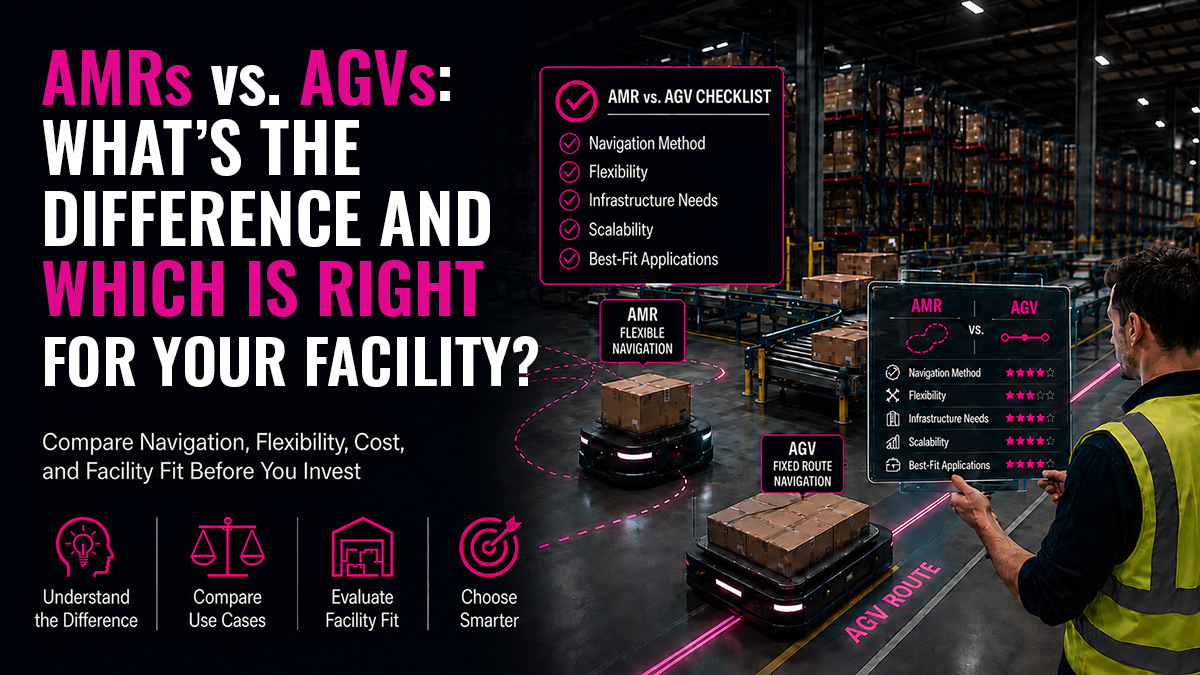
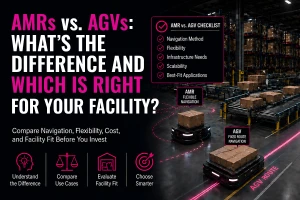
AGVs (automated guided vehicles) follow a fixed, pre-programmed path defined by wires, magnetic tape, or floor markers, and they stop and wait if that path is blocked. AMRs (autonomous mobile robots) use onboard sensors, cameras, and mapping software to build a live picture of the facility and dynamically plan or re-plan their own route around obstacles and people. AGVs are typically less expensive per unit and well suited to stable, high-volume, repetitive routes, such as tow tractor lines in an automotive plant. AMRs cost more per unit but need little to no infrastructure investment, can deploy in days rather than months, and adapt when your layout, SKU mix, or seasonal volume changes. The right choice, or the right mix of both, depends on how often your facility's routes and workflows actually change.
Have Questions About AMRs or AGVs?
Get straight answers from Warehouse1's automation team.
No obligation, no sales pressure.
The stakes are rising because more operations are automating at all. According to MHI's 2025 Annual Industry Report, 45% of supply chain leaders plan to purchase automated material handling solutions and 83% expect to adopt robotics and automation of some kind within the next five years. Getting the AMR-versus-AGV decision right the first time avoids a costly do-over.
What Is an AGV, and How Does It Navigate?
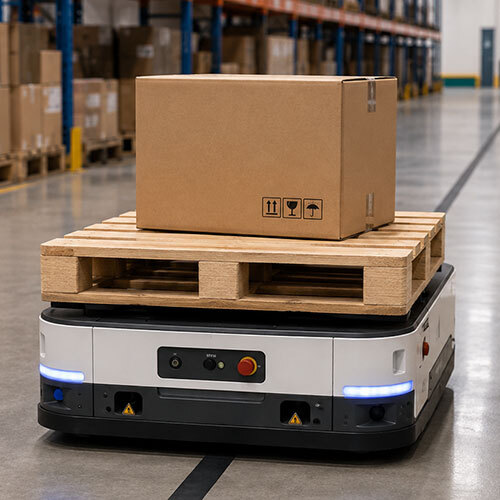 An automated guided vehicle, or AGV, moves along a route that is defined before it ever runs. That route can be a magnetic strip embedded in the floor, buried wire, reflective targets a laser scanner tracks, or a QR code grid, but the principle is the same: the path exists first, and the vehicle follows it. If a pallet, a person, or a forklift blocks that path, the AGV stops and waits for the obstruction to clear, because it has no way to plan an alternate route on its own.
That rigidity is a feature, not a flaw, in the right setting. AGVs excel at high-volume, repetitive transport between fixed points, such as moving totes from receiving to a stable putaway zone or towing parts carts along an assembly line that has not changed in years. AGVs are governed primarily by ANSI/ITSDF B56.5, the Safety Standard for Driverless, Automatic Guided Industrial Vehicles, first published in 1978 and built around the assumption of a predetermined guidepath.
What Is an AMR, and How Does It Navigate?
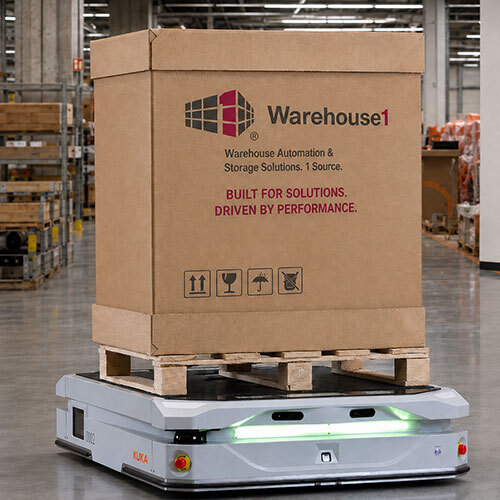 An autonomous mobile robot, or AMR, does not need a predefined path at all. Using LiDAR, 3D cameras, and mapping software, often built on simultaneous localization and mapping (SLAM) technology, an AMR builds a live digital map of the facility, localizes itself within it, and calculates the most efficient route to a destination on its own. When something blocks that route, the AMR detects it, re-plans, and continues, generally without stopping to wait for a person to intervene.
That adaptability makes AMRs a strong fit for environments that change often: e-commerce fulfillment with a shifting SKU mix, seasonal volume swings, or facilities that reconfigure pick zones several times a year. AMRs and other industrial mobile robots fall under ANSI/RIA R15.08, a newer safety standard finalized in 2020 specifically to address machines capable of planning and re-planning their own routes around people.
AMR vs. AGV: Side-by-Side Comparison
| Factor | AGV | AMR |
|---|---|---|
| Navigation | Wire, magnetic tape or spots, QR codes, or laser reflectors | Onboard LiDAR, cameras, and SLAM-based mapping |
| Obstacle response | Stops and waits for the path to clear | Dynamically re-plans a route around it |
| Infrastructure required | Floor tape, magnets, wiring, or reflector targets | Minimal; primarily a mapping pass and network access |
| Typical deployment | Weeks to months, often with facility downtime | Days to a few weeks, with limited disruption |
| Governing safety standard | ANSI/ITSDF B56.5 | ANSI/RIA R15.08 |
| Best-fit environment | Stable, high-volume, repetitive routes | Layouts and SKU mixes that change often |
| Changing a route later | Requires moving or reinstalling physical guidance | Reprogrammed in software, often same day |
Cost and Total Cost of Ownership: What Actually Drives the Number
Comparing sticker prices alone is misleading. An AGV can look cheaper on the quote, but the true project cost includes the guidance infrastructure, and that cost repeats every time a route needs to change. An AMR usually carries a higher per-unit price, offset by lower installation cost and faster redeployment. Combined hardware costs across both technologies span roughly $40,000 for an entry-level flat-platform AMR to $300,000 or more for a complex AGV forklift system, and buyers should generally budget an additional 30% on top of hardware for engineering, integration, and deployment, according to equipment finance firm CHG-MERIDIAN.
| +30% Typical cost added for engineering, integration, and deployment, on top of hardware | $40K–$300K+ Combined hardware range across AGV and AMR platforms, by complexity | 12–24 mo Payback window reported across typical industrial mobile robot deployments |
Source: CHG-MERIDIAN, "AGV and AMR Adoption Costs and Financing" (2026).
Safety Standards: Two Different Rulebooks
Because AGVs and AMRs move so differently, they are not certified under the same document. Confusing the two, or assuming one standard covers both, is a compliance gap worth closing before equipment ever hits the floor.
| ANSI/ITSDF B56.5 Safety Standard for Driverless, Automatic Guided Industrial Vehicles. First published in 1978 and written for vehicles that follow a predetermined guidepath and stop when that path is blocked. This is the standard that governs most traditional AGVs. | ANSI/RIA R15.08 Industrial Mobile Robots, Safety Requirements. Finalized in 2020 by a joint ANSI and RIA committee formed in 2016, built specifically for machines like AMRs that plan and re-plan their own routes around people and obstacles in real time. |
Sources: Association for Advancing Automation, Robotics Online; International Federation of Robotics.
Market Momentum: Why the Balance Keeps Shifting Toward AMRs
The mobile robot market, AGVs and AMRs combined, is on pace for roughly 19% annual growth through 2030, but the mix inside that number is changing fast. Analyst firm Interact Analysis projects AGV revenue's share of the total mobile robot market will fall from 33% in 2024 to about 20% by 2030, as more operations choose AMR-based platforms for their flexibility. The firm also projects the worldwide installed base of mobile robots will exceed 4.2 million units by 2030, up from a much smaller base today, and notes that fewer than one in seven warehouses had deployed even a single fulfillment AMR as of its most recent forecast, which suggests most of this growth is still ahead rather than behind.
Source: Interact Analysis, "Mobile Robots Market Outpaces Fixed Automation with 19% Annual Growth to 2030" (2026).
Which Is Right for Your Facility? A Decision Framework
Start with one question: how often do your routes, your layout, or your SKU mix actually change? The answer points toward one platform more than the other, and often toward using both.
|
Consider an AGV If
|
Consider an AMR If
|
5 Mistakes to Avoid When Choosing Between AMR and AGV
Frequently Asked Questions
Not Sure If An AMR, An AGV, Or Both Is Right For Your Facility?
Warehouse1's team evaluates your travel paths, SKU mix, and growth plans against every mobile robot platform on the market, not just one brand, so the recommendation fits your operation instead of a sales quota. Start with a free, no-obligation facility assessment.
About Warehouse1
Warehouse1 has been solving material handling and warehouse automation problems since 1988. As a 100% employee-owned company based in Kansas City, Missouri, Warehouse1 acts as a single point of accountability from design through supply and installation — evaluating ASRS, vertical lift modules, robotics, automated conveyor, and pick module systems on their merits, not on which one is easiest to sell. Warehouse1 serves distribution centers, e-commerce, automotive, aerospace, and food and beverage operations, and is a member of the Material Handling Equipment Distributors Association (MHEDA).
| Smarter Solutions, Not Just SKUs. Solutions designed around your operation's actual needs and goals, not a product catalog. | One Partner. End-to-End Execution. From facility assessment and layout design to installation and post-go-live support. |
| Easy to Work With at Every Stage. Simplifying complex projects and reducing operational disruption throughout. | Trusted Expertise. Proven Results. Decades of practical experience across the full range of material handling systems. |
Sources & Further Reading
- MHI, 2025 Annual Industry Report, "The Digital Supply Chain Ecosystem"
- Interact Analysis, "Mobile Robots Market Outpaces Fixed Automation with 19% Annual Growth to 2030" (2026)
- Interact Analysis, "Macro-Economic Factors Cause Slowdown in Global Mobile Robot Market" (2025)
- Association for Advancing Automation (A3), Jeff Burnstein interview, Robotics 24/7
- A3 Robotics Online, "Mobile Robot Standard R15.08-1-2020, What You Need to Know"
- International Federation of Robotics, "New U.S. Standard Sets the Bar for Industrial Mobile Robot Safety"
- ANSI Webstore, ANSI/RIA R15.08-1-2020, Industrial Mobile Robots, Safety Requirements
- CHG-MERIDIAN, "AGV and AMR Adoption Costs and Financing" (2026)
- KUKA, "AGV vs. AMR: Differences, Applications, Costs & Decision Support"