Pallet Rack Accessories Explained: Types, Uses & Safety Standards
Sep 29th 2026
The safety, product-containment, and compliance components that protect a steel rack frame and the people working around it
While a pallet rack's steel frame (uprights and beams) is what does the heavy lifting by carrying the load, pallet rack accessories have a different job. Wire decking, row spacers, flue space keepers, column protectors, beam safety pins, and load capacity labels keep product contained, protect the structure from damage, help preserve fire protection clearances, and support the safety and compliance of the installation. Skipping the right ones can turn a sound rack into a liability.
This guide breaks down the major categories of pallet rack accessories, what each one actually does, which standards govern them, and how to decide what a specific facility needs based on load type, forklift traffic, and fire protection design. It is written for operations and facility managers evaluating a new rack layout or auditing an existing one, not for engineers designing custom rack from scratch.
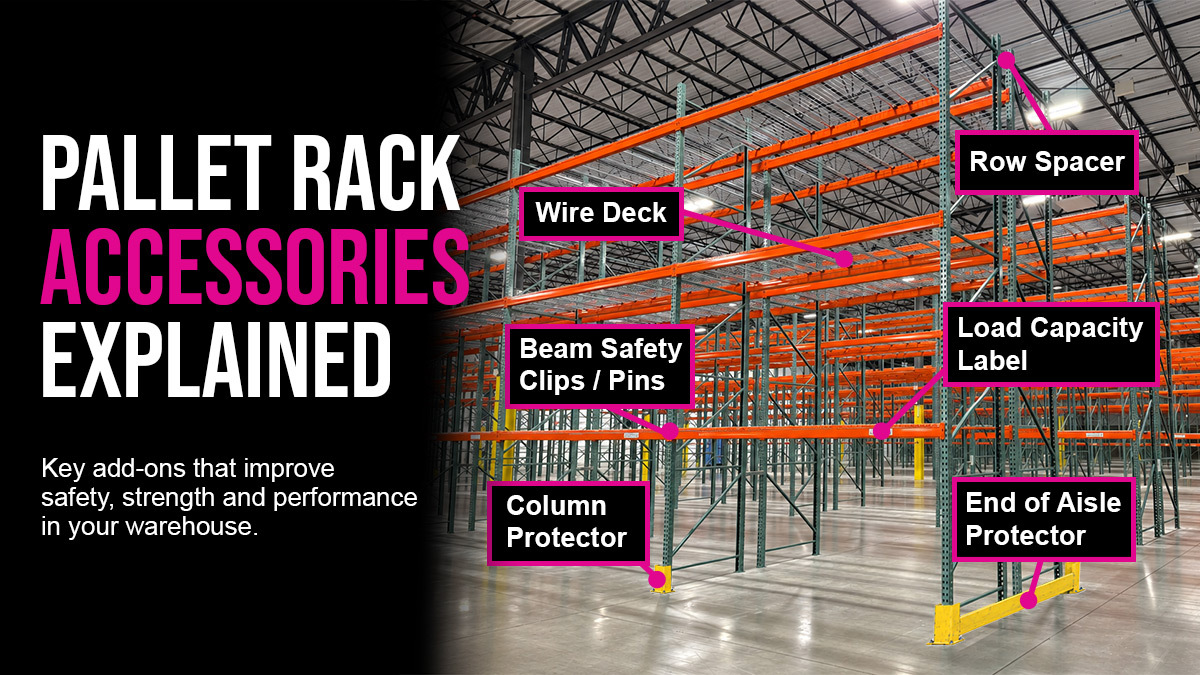
Pallet rack accessories keep stored product contained, protect the rack structure from damage, and support fire code and safety compliance. Wire decking catches product that falls off a pallet and lets dust and sprinkler water pass through, and row spacers keep back-to-back runs evenly spaced while flue space keepers stop pallets from being pushed into the flue. Column protectors, end-of-aisle protectors, and beam safety pins guard the structure against impact and dislodged beams. Load capacity labels document the rack's rated limits, called for by ANSI MH16.1 though whether one is legally required depends on your local code. The right mix depends on what you store, how forklifts move through the facility, and what your fire protection design requires.
Get the Right Accessories for Your Rack
Warehouse1's pallet rack experts can recommend the exact
accessories your operation needs.
Why This Is Getting More Attention Right Now
Warehouse racking has moved higher on regulators' priority list. In August 2026, OSHA renewed its National Emphasis Program covering warehousing and distribution center operations, extending it from three years to 5 years of continuous, targeted inspection activity. In the program's first 18 months alone, OSHA identified more than 1,700 violations and removed an estimated 37,410 workers from hazardous conditions. Rack condition and safe storage practices fall squarely inside that scope, which makes the accessories that protect and document a rack worth a second look.
| 5 yrs Length of OSHA's renewed Warehousing NEP, up from 3 years | 1,700+ Violations identified in the NEP's first 18 months | 37,410 Workers removed from hazardous conditions in that period | 2023 Year the Warehousing NEP first launched |
Source: OSHA, National Emphasis Program – Warehousing and Distribution Center Operations, Instruction CPL 03-00-026 (renewed August 2026).
What Counts as a Pallet Rack Accessory?
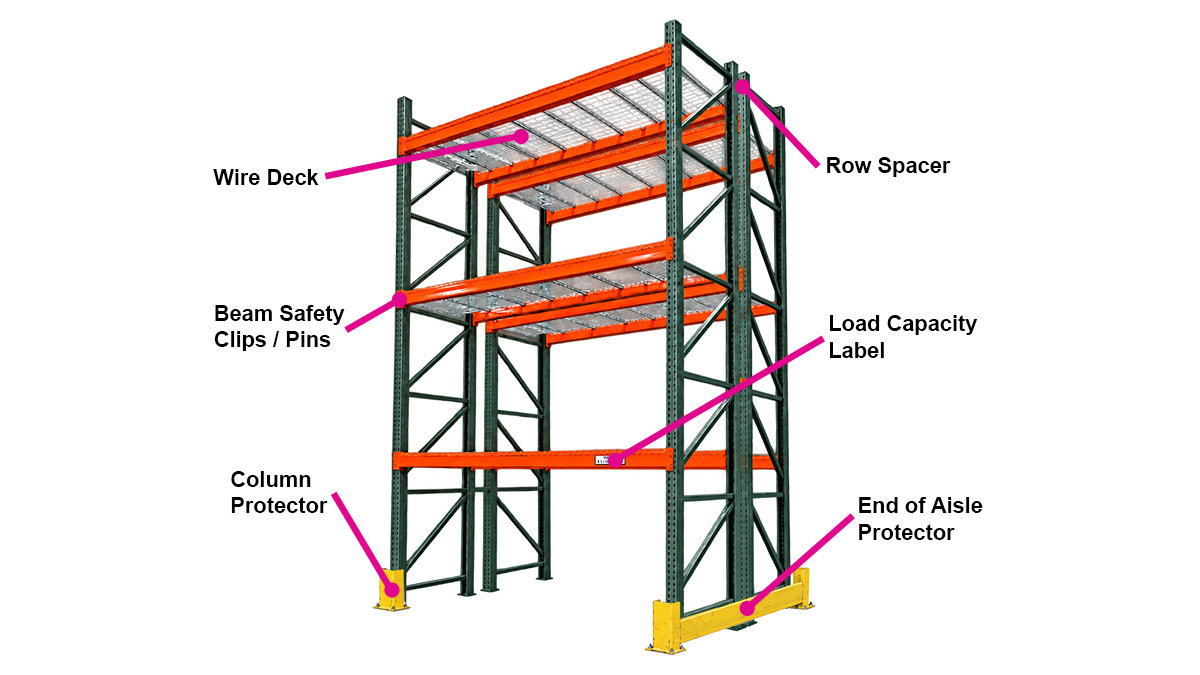
Everything installed on or around pallet rack beams and uprights is an accessory that does one of three jobs: storage and product-containment accessories that catch or steady what is stored, protective accessories that shield the structure and workers from impact or falling product, and identification and compliance accessories that document what the rack is rated to hold and help keep it aligned with fire and building code. A single rack bay can include accessories from all three groups at once. The diagram below shows where the most common accessories typically sit on a standard bay, and the sections that follow cover each group in detail.
Storage & Product-Containment Accessories
Wire decking is the most common rack accessory, and also the easiest to misunderstand. It is a welded wire mesh panel that sits across a pair of beams. Its job is to catch product that falls off a pallet, keep smaller items from dropping to the level below, and let light, dust, and sprinkler water pass through. It is not what carries the load. Pallets should still rest on both beams, and decking is rated for a uniformly distributed static load, not a point load, so weight should never be concentrated on one spot and a deck should never be stood or walked on.
Every deck comes with a stated capacity, and heavy duty styles are commonly rated at 2,500+ lb, but that number describes the deck alone. It never adds to the capacity of the beams or uprights beneath it. Match the profile to your beam, either a waterfall style that drops over the beam edge or a flush style that sits in the beam step, and fasten panels the way the manufacturer specifies so they stay put during product placement and removal. Warehouse1 stocks wire decking in common pallet rack sizes.
Pallet supports serve a narrower purpose than decking. Instead of covering the entire bay, individual support bars run front to back between beams to give a pallet or container extra support underneath, which is useful when a load does not bridge the beams well and the bay should stay open for airflow and sprinkler water.
Row Spacers vs. Flue Space Keepers
Row spacers are steel connectors that bolt between two back-to-back runs of rack. Their job is to hold the runs at an even, consistent distance apart along the length of the row, with the intention of preserving the flue space, the open channel between rows that lets heat and sprinkler water move through the rack in a fire. What a row spacer cannot do is control what is stored on the beams. Pallets and other items on any level can be pushed back into that gap and block it, and a blocked flue defeats the purpose of the fire protection design.
The accessory that actually protects the flue space is a flue space keeper, also called a flue space divider or pallet safety stop. It mounts on the beams and physically stops a pallet from being pushed past it. These accessories are typically designed to hold a fixed flue space of 6 inches or more and are offered in several stock sizes to meet local building and fire code, including IBC and NFPA 13 where applicable. The dimension your facility needs comes from your fire protection design and local authority, so confirm it with your fire protection engineer before choosing a size.
Safety & Protection Accessories
Column and upright protectors wrap around the base of a rack frame to absorb impact from forklifts and pallet jacks before it reaches the structural steel. This matters because a collision can bend an unprotected upright, and a damaged upright can reduce the capacity of the section it supports. Protectors are inexpensive compared with the cost of pallet rack repair, a partial re-rack, or the downtime that follows a damaged frame.
Guard rails and end-of-aisle protection extend that same logic to the areas where forklifts turn, approach a dock, or cross paths with pedestrians. These zones tend to see the most vehicle traffic and turning, which is why guard rails are typically prioritized there even in facilities that do not protect every column throughout the building.
Beam safety clips and locking pins secure each beam to its upright connector so that an impact or an accidental lift cannot dislodge the beam from the frame. They are small, easy to overlook, and simple to lose during reconfiguration, which is why they deserve a spot on every inspection walk.
Wire mesh backing and rack netting contain product that could otherwise fall into an aisle or through the flue space between back-to-back rows. They are especially common behind racks that face active aisles or pedestrian walkways, where a falling case or loose item poses a direct injury risk rather than just an inventory loss.
Identification & Compliance Accessories
OSHA does not name specific rack accessories in its regulations. What it does say, under 29 CFR 1910.176(b), is that storage of material shall not create a hazard and that stacked materials must be stable and secure against sliding or collapse. In practice, ANSI MH16.1, the RMI-developed and ANSI-approved standard for the design, testing, and utilization of industrial steel storage racks, serves as the industry benchmark, and the International Building Code references it.
That standard is where the load capacity label comes from. ANSI MH16.1 calls for a permanent label of at least 50 square inches, displayed on or near the rack, showing the maximum unit load and the maximum load per level and per bay for that configuration, and it places responsibility for keeping it displayed on the rack owner. A label is not automatically required everywhere, though. OSHA does not name labels in its rules, so whether one is legally required in your building depends on local code, your insurer, and how the rack was specified, and older or used rack may have none at all. Even where it is optional, a capacity label is a low-cost best practice. One that no longer matches the current beam layout is misleading, so any change to beam heights or bay configuration should be reviewed by the rack manufacturer or a qualified engineer and the label updated.
Aisle and location labels and warning mirrors round out this category. They are lower stakes individually but add up to a facility that is easier to inspect, easier to audit, and easier for new staff to work in safely.
| Accessory | Primary Function | Typically Governed By | Priority |
|---|---|---|---|
| Wire Decking | Catches product that falls off a pallet; passes light, dust, and sprinkler water | ANSI MH26.2 (rack decking) | Situational; uniformly distributed loads only |
| Pallet Supports | Adds support under pallets or containers that don't bridge the beams well | Manufacturer load rating | Situational |
| Row Spacers | Holds back-to-back runs at an even, consistent distance | Fire protection design / local fire code | Common on back-to-back runs |
| Flue Space Keepers | Stops pallets from being pushed into the flue space | IBC / NFPA 13 and local fire code | Recommended wherever a flue space must stay clear |
| Column / Upright Protectors | Absorbs forklift impact before it reaches the structure | Facility risk assessment | Recommended in high-traffic zones |
| Guard Rails / End-of-Aisle Protection | Shields uprights and aisle ends from vehicle contact | Facility risk assessment | Recommended |
| Beam Safety Clips / Pins | Locks beams to uprights so impact can't dislodge them | ANSI MH16.1 | Standard practice on every beam |
| Wire Mesh Backing / Netting | Contains product that could fall into aisles or flue space | Facility risk assessment / OSHA 1910.176(b) | Situational |
| Load Capacity Label | Documents rated capacity per unit load, per level, per bay | ANSI MH16.1; local code and insurer requirements vary | Called for by ANSI MH16.1; legal requirement varies |
How to Choose the Right Accessories for Your Facility
There is no universal accessory package that fits every warehouse. The right combination comes out of a short, structured review of the facility itself, and Warehouse1's pallet racking systems team can walk through it with you.
|
1
|
Map Your Load Types Profile what's actually stored: pallet weight, footprint, and whether cases or totes sit on wire decking instead of full pallets resting on both beams. |
|
2
|
Confirm Fire Protection Design Check sprinkler type and required flue spacing with your fire protection engineer before finalizing row spacer and flue space keeper plans. |
|
3
|
Assess Collision Risk Zones Walk the layout, ideally with a Warehouse Space Checklist in hand, for tight turns, dock approaches, and cross traffic where protective accessories matter most. A professional warehouse layout design review can catch problem spots early. |
|
4
|
Verify Capacity Signage Confirm every bay has an accurate, legible label that matches its current beam configuration, and have it updated after any warehouse reconfiguration project. |
|
5
|
Build In Routine Inspection Schedule an annual professional inspection or facility survey and give staff a simple internal checklist to flag damage between visits. |
Common Mistakes That Turn Accessories Into Liabilities
Frequently Asked Questions
Get the Right Accessories for Your Racking System
Warehouse1's team can walk your facility, review your current rack configuration, and recommend the exact wire decking, flue space, and safety accessories your operation needs, not a generic list from a catalog.
About Warehouse1
Warehouse1 has been solving material handling and warehouse automation problems since 1988. As a 100% employee-owned company based in Kansas City, Missouri, Warehouse1 acts as a single point of accountability from design through supply and installation, evaluating ASRS, vertical lift modules, robotics, automated conveyor, and pick module systems on their merits, not on which one is easiest to sell. Warehouse1 serves distribution centers, e-commerce, automotive, aerospace, and food and beverage operations, and is a member of the Material Handling Equipment Distributors Association (MHEDA).
| Smarter Solutions, Not Just SKUs. Solutions designed around your operation's actual needs and goals, not a product catalog. | One Partner. End-to-End Execution. From facility assessment and layout design to installation and post-go-live support. |
| Easy to Work With at Every Stage. Simplifying complex projects and reducing operational disruption throughout. | Trusted Expertise. Proven Results. Decades of practical experience across the full range of material handling systems. |
Sources & Further Reading
Occupational Safety and Health Administration, National Emphasis Program – Warehousing and Distribution Center Operations (renewed August 2026): osha.gov/quicktakes/080626
Occupational Safety and Health Administration, Instruction CPL 03-00-026: osha.gov/sites/default/files/enforcement/directives/CPL-03-00-026.pdf
Occupational Safety and Health Administration, 29 CFR 1910.176, Handling Materials – General: osha.gov/laws-regs/regulations/standardnumber/1910/1910.176
Rack Manufacturers Institute, Welded Wire Decking Safety 101: rmiracksafety.org
Rack Manufacturers Institute, Understanding Rack Decking Capacity Ratings: rmiracksafety.org
Rack Manufacturers Institute, Load Plaques: Why Your Rack Installation Needs Them: rmiracksafety.org
Rack Manufacturers Institute, New Storage Racking and Decking Infographic: rmiracksafety.org
ANSI Blog, Industrial Steel Storage Rack Safety: ANSI MH16.1-2023: blog.ansi.org
The New Warehouse, MHI Industry Series: Pallet Racking Safety and Standards from the Rack Manufacturers Institute: thenewwarehouse.com