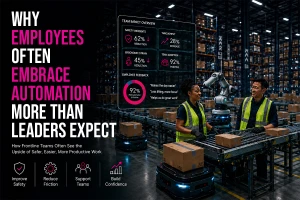
Why Employees Often Embrace Automation More Than Leaders Expect
Oct 23rd 2026
The Data Says Frontline Workers Are Ready. Is Leadership?
Ask a warehouse operations leader what worries them most about an automation project, and budget usually tops the list. Ask what worries them second, and a lot of leaders say the same thing: how the team is going to react. There is a quiet assumption baked into a lot of automation planning that longtime employees will see a new robot, conveyor line, or goods-to-person system as a threat, that morale will dip, and that winning people over will be the hardest part of the project.
That assumption is understandable. It is also, according to the people who have actually gone and asked warehouse workers what they think, mostly wrong. Across multiple recent industry surveys, most frontline associates report a more positive view of automation than the leaders deploying it expect, and in several studies, workers describe wanting more of it, not less. The real risk for most operations is not that the floor will resist. It is that leadership delays a project over a resistance problem that research suggests is smaller than it looks, while the factors that actually determine success, like training, communication, and workflow design, get less attention than they deserve.
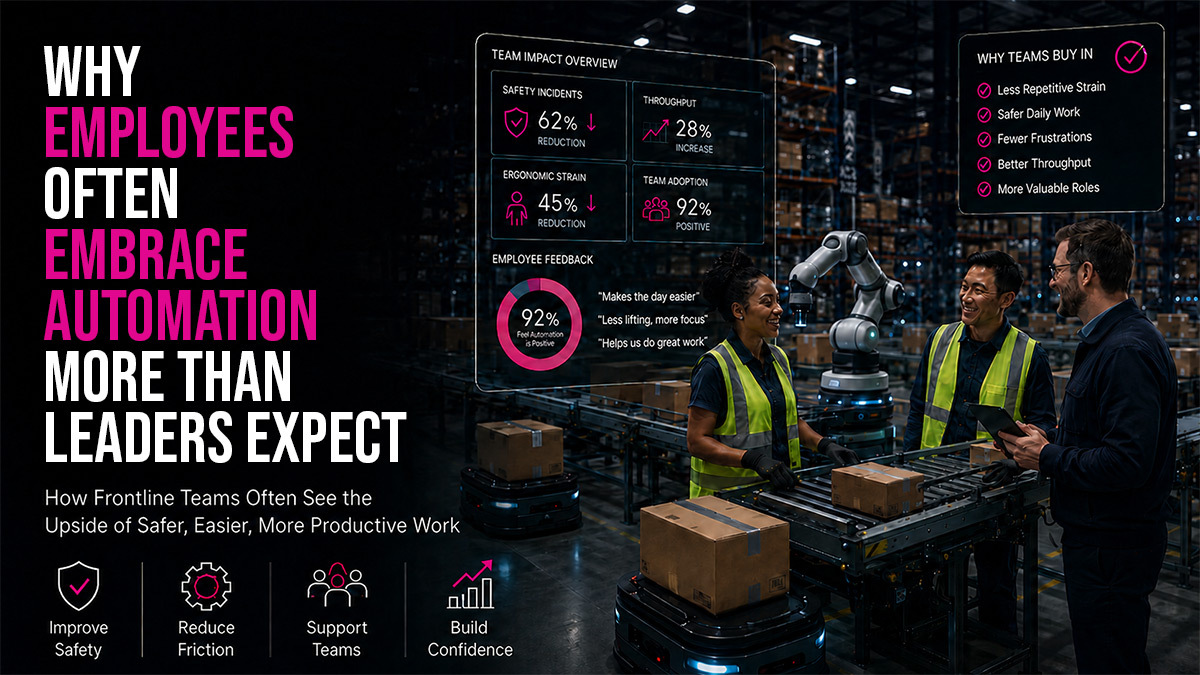
Multiple recent industry surveys, including Exotec's 2025 Warehouse Workers Sentiment Report and Zebra Technologies' Warehousing Vision Study, find that most warehouse associates view automation positively rather than as a threat to their jobs. Seven in 10 workers say they are open to or interested in working alongside automation, and nearly all who already work with it call it a boost to their productivity. Much of the resistance leaders anticipate turns out to be a leadership assumption more than a workforce reality: MHI's 2025 Annual Industry Report found that budget, business case clarity, and technical understanding rank as the leading barriers to automation adoption, not employee pushback. Where hesitation does show up, it tends to fade quickly once workers get hands-on experience with the technology. The bigger risk for most operations is not worker resistance, it is failing to train, communicate, and involve the floor well enough to keep the goodwill that is already there.
Warehouse1's experts can help you evaluate the right
automation technology for your operations
The Fear That Shapes the Budget Conversation
The worry is not irrational. Automation has been a headline topic for years, and a lot of those headlines lead with job loss. Add in a bad experience with a past software rollout or a new process that nobody explained well, and it is easy to see why a plant manager or VP of operations would pencil in months of change management before a single robot arrives.
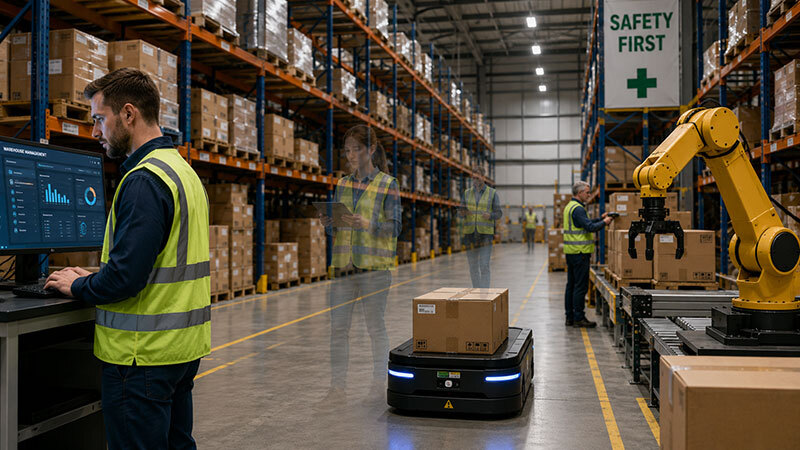
But when MHI and Deloitte surveyed more than 1,000 manufacturing and supply chain professionals for the 2025 Annual Industry Report, employee resistance did not top the list of adoption barriers. Budget led the way at 41%, followed closely by cost and ROI concerns at 40%, with a general lack of technical understanding close behind. Culture and workforce pushback were not the story.
Meanwhile, the same report found that 45% of companies rate talent shortages as extremely challenging, and 52% say the same about hiring and retaining labor. In other words, the workforce pressure most operations feel is not employees blocking automation. It is not having enough people to run the warehouse without it.
That is a fitting way to describe where a lot of operations sit today. Leadership already feels pressure to modernize. Increasingly, so does the floor.
What Warehouse Workers Actually Say When You Ask Them
Two recent studies put real numbers behind that shift. Exotec's Warehouse Workers Sentiment Report surveyed more than 400 U.S. warehouse associates in late 2025 about their direct experience working alongside automation. Zebra Technologies' Warehousing Vision Study went broader, surveying more than 1,700 warehouse associates and decision-makers across manufacturing, retail, transportation, and wholesale distribution. The two studies used different methods and different samples, but they land on a similar conclusion: workers who are close to automation tend to like what they see.
Source: Exotec, Warehouse Workers Sentiment Report, 2025, as reported by Modern Materials Handling and SupplyChainBrain.
The pattern holds even among workers who started out skeptical. In Exotec's survey, workers who were initially suspicious of automation most often changed their minds because it helped with physically difficult work, made their job easier, or proved it was not the job-security threat they expected. Roughly half of respondents described themselves as optimistic about automation's role in their workplace, compared to about a third who called themselves reluctant, and workers who had received training on the systems they worked with were nearly twice as likely to land in the optimistic camp.
Why the Floor Sees It Differently Than the C-Suite Expects
Part of the explanation is straightforward: automation projects tend to target the tasks warehouse workers already dislike most. The Association for Advancing Automation, the trade group representing robotics and automation manufacturers, describes this as the "dull, dirty, and dangerous" work automation is best suited to take on first, things like repetitive lifting, high-frequency travel across a facility, or the task nobody wants at 2 a.m. during peak season.

That lines up with what workers report. In Zebra's study, 72% of associates raised concerns about safety on an increasingly busy warehouse floor, and 70% specifically worried about injury. Nearly nine in 10 said they were open to working with collaborative robots, ergonomic mobile devices, and better task management tools, the exact categories of technology built to reduce physical strain.
There is a financial angle too. A3 has pointed out that entry-level roles tied to robotics and automation tend to pay meaningfully more, often cited around 30% higher, than comparable non-automation entry-level manufacturing roles. Exotec's survey found similar movement on the warehouse floor: workers connected automation to pay increases and to a better shot at a raise or promotion.
|
93%
of associates say automation and mobile technology help attract and retain warehouse talent
|
89%
feel more valued by their employer when given tools that help them do the job
|
|
81%
of warehouse leaders say automation improves floor morale
|
88%
of associates are open to working with collaborative robots
|
Source: Zebra Technologies, Warehousing Vision Study, 2024–2025.
Put together, the appeal is not abstract. Automation shows up on the floor as less physical strain, fewer safety close calls, steadier staffing during peak season, and in a lot of cases, a bigger paycheck. That is a different value proposition than the one a lot of leaders assume they need to sell.
Where Leaders Are Right to Be Cautious
None of this means employee sentiment is guaranteed or permanent. It means the starting point is better than most leaders expect, and what happens next determines whether it holds.
Training is the clearest gap. Only 51% of workers in Exotec's survey said their employer offered internal training tied to the automation they work with, even though trained workers were far more likely to describe themselves as optimistic about it. Skipping that step does not just slow adoption. It hands early skeptics a reason to stay skeptical.

There is a broader version of the same problem at the organizational level. Deloitte's Global Human Capital Trends research, cited in MHI's 2025 report, found that 73% of companies believe their people's capabilities need to keep pace with new technology, but only 9% feel they are actually making progress on that front. Deloitte calls the resulting shortfall an "imagination deficit," a gap between the technology a company deploys and its readiness to help people work alongside it well.
In practice, that gap tends to show up as one of a few specific missteps:
Turning Worker Readiness Into a Successful Rollout
The data suggests most warehouse teams are closer to ready than leadership assumes. The projects that make the most of that readiness tend to share a few habits.
|
1
|
Explain the why before the what. Lead with the safety, workload, or growth problem automation is solving, not just the equipment being installed. |
|
2
|
Bring floor supervisors and veteran associates into the design process. Their input on layout and workflow usually surfaces issues an engineering drawing misses. |
|
3
|
Build training into the project timeline. Treat it as a deliverable with its own schedule, not a task squeezed into go-live week. |
|
4
|
Publish a clear path for every affected role. People adapt faster to change when they can see a place for themselves in it. |
|
5
|
Track and share early wins. Momentum compounds goodwill. Silence lets doubt fill the gap instead. |
None of this requires guessing. It requires planning the human side of an automation project with the same rigor as the technical side, which is where an experienced integration partner earns its keep.
Frequently Asked Questions
Common questions warehouse leaders ask about employee sentiment and warehouse automation.
Ready to Build an Automation Plan Your Team Will Actually Support?
Warehouse1's experts can help you evaluate the right automation technology and plan a rollout, training and communication included, that builds on the readiness your team already has.
About Warehouse1
Warehouse1 has been solving material handling and warehouse automation problems since 1988. As a 100% employee-owned company based in Kansas City, Missouri, Warehouse1 acts as a single point of accountability from design through supply and installation, evaluating ASRS, vertical lift modules, robotics, automated conveyor, and pick module systems on their merits, not on which one is easiest to sell. Warehouse1 serves distribution centers, e-commerce, automotive, aerospace, and food and beverage operations, and is a member of the Material Handling Equipment Distributors Association (MHEDA).
| Smarter Solutions, Not Just SKUs. Solutions designed around your operation's actual needs and goals, not a product catalog. | One Partner. End-to-End Execution. From facility assessment and layout design to installation and post-go-live support. |
| Easy to Work With at Every Stage. Simplifying complex projects and reducing operational disruption throughout. | Trusted Expertise. Proven Results. Decades of practical experience across the full range of material handling systems. |
Sources & Further Reading
- Exotec, Warehouse Workers Sentiment Report: Understanding the Impact of Automation on Retention and Satisfaction, as reported by Modern Materials Handling, 2025. mmh.com
- Exotec Warehouse Workers Sentiment Report, productivity and sentiment data, as reported by SupplyChainBrain, 2025. supplychainbrain.com
- Zebra Technologies, Warehousing Vision Study: Elevating Every Move, as reported by Automated Warehouse, 2025. automatedwarehouseonline.com
- MHI and Deloitte, 2025 Annual Industry Report: The Digital Supply Chain Ecosystem, summarized by Made4net, 2025. made4net.com
- Association for Advancing Automation (A3), Advocacy Principles for the U.S. automate.org