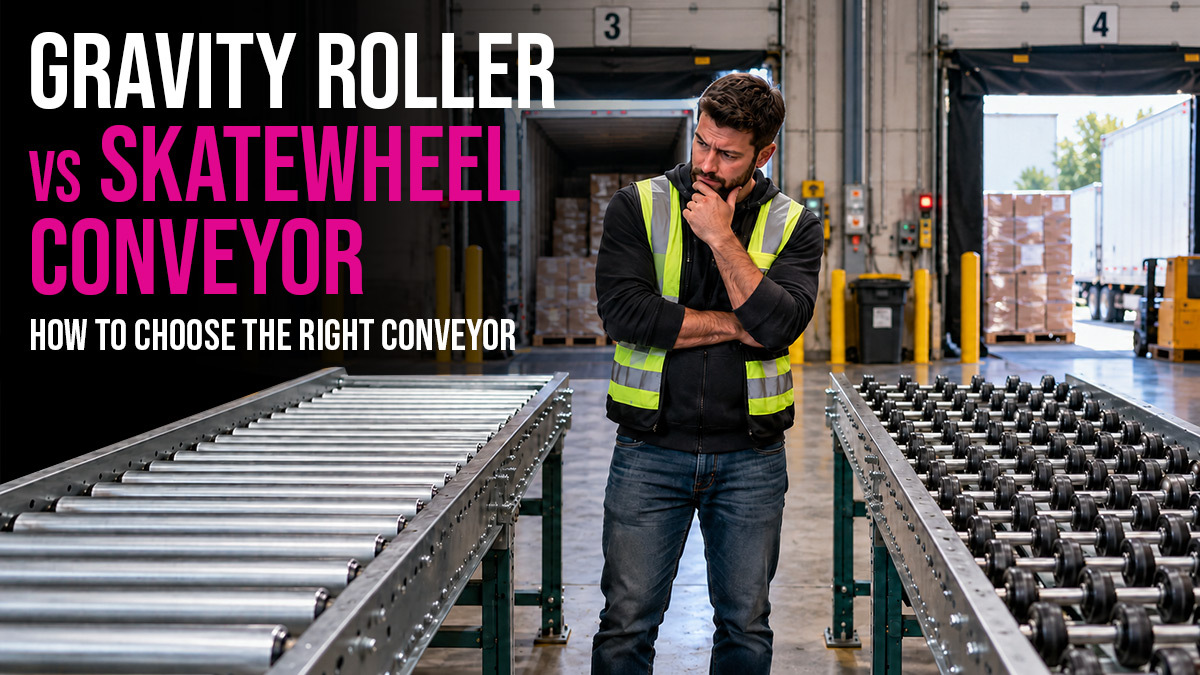
Gravity Roller vs. Skatewheel Conveyor: How to Choose the Right Gravity Conveyor
Posted by Warehouse1 on Nov 9th 2026
How load type, pitch, capacity, and layout decide which non-powered conveyor belongs in your operation
Gravity conveyor is one of the simplest, most economical ways to move cartons, totes, and parts through a warehouse. There are no motors to wire, no controls to program, and very little to maintain. Yet the choice between the two most common styles, gravity roller and skatewheel, is where many operations go wrong. Specify the wrong one and you get cartons that stall mid-run, totes that hang up on wheels, product that tips on curves, or a line that sends heavy cases crashing into the end stop.
This guide breaks down how gravity roller conveyor and skatewheel conveyor differ, which loads each handles best, how much pitch and capacity each needs, and the specification rules that keep product flowing. It also shows where a simple gravity line fits into a broader plan for automated conveyor systems as your volume grows.
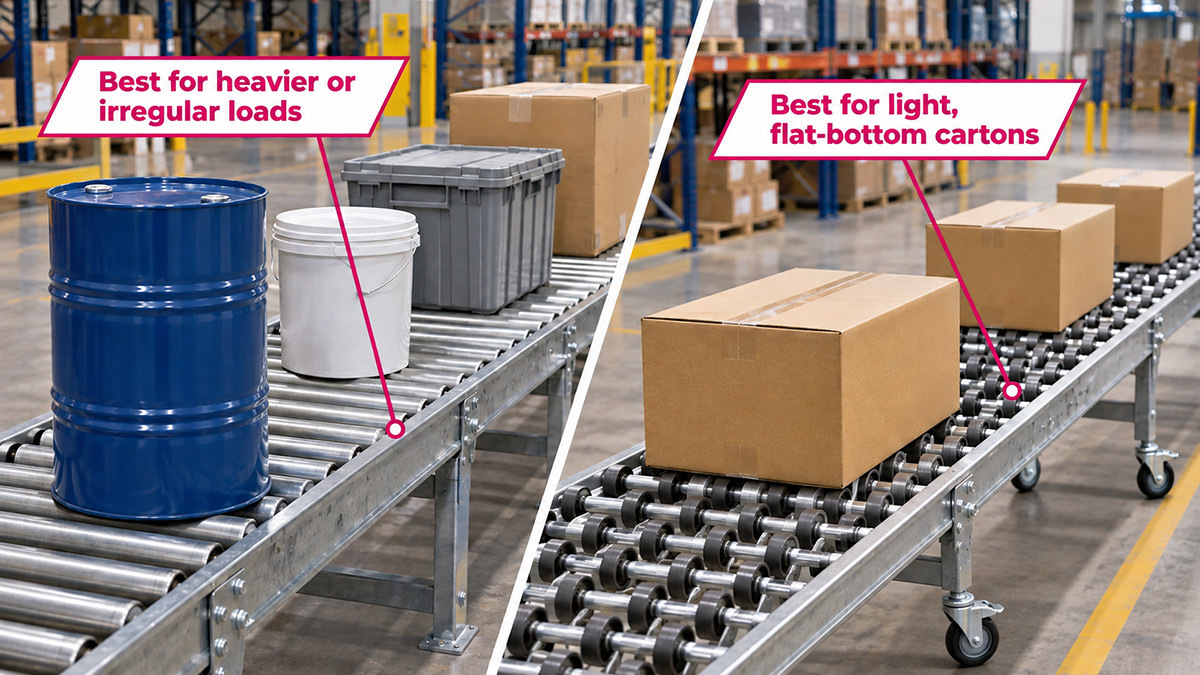
Gravity roller conveyor uses full-width tubular rollers and is the better choice for heavy, irregular, soft-bottomed, or rimmed loads such as drums, pails, bags, and ribbed totes. Skatewheel conveyor uses rows of small, independently spinning wheels on axles, so it needs less pitch to keep product moving, holds carton orientation better through curves, and weighs less, which makes it ideal for lightweight, flat, rigid-bottomed cartons and portable or temporary lines. As a rule of thumb, keep at least three rollers or ten skatewheels under every load at all times. If anything in your product mix is not flat, firm, and light, specify roller.
Roller or Skatewheel? Ask Our Experts
Get a free, no-obligation review of your loads and layout from Warehouse1's conveyor specialists.
What Is the Difference Between Gravity Roller and Skatewheel Conveyor?
Both are gravity conveyors, meaning the conveyor is set on a slight decline (or pushed by hand) and gravity does the work. The difference is the conveying surface. A gravity roller conveyor places one full-width roller at each axle position along the frame, typically on spring-loaded axles that make individual rollers easy to remove and replace. A skatewheel conveyor places several small wheels side by side on each axle, usually in a staggered pattern, so the load rides on many independent contact points instead of continuous tubes.
That one design difference drives almost everything else: how much weight the line can carry, how much slope it needs, how product behaves on curves, and which packages it can move at all.
Illustration: Warehouse1. Schematic only; roller centers, wheel patterns, and widths vary by manufacturer and model.
Gravity Roller vs. Skatewheel Conveyor: Side-by-Side Comparison
Use this table as a first-pass filter. If a row lands firmly on one side for your product, it usually settles the decision.
| Factor | Gravity Roller | Skatewheel |
|---|---|---|
| Conveying surface | Full-width tubular rollers on spring-loaded axles | Multiple small wheels per axle, usually staggered |
| Best load types | Heavy, irregular, soft, rimmed, or open-bottom loads: drums, pails, bags, ribbed totes | Light, flat, firm-bottomed cartons, cases, and smooth totes |
| Minimum support under load | At least 3 rollers | At least 10 wheels |
| Pitch needed to flow | More | Less |
| Behavior on curves | Load can drift or rotate | Differential wheel action helps hold orientation |
| Load width vs. conveyor | Load should not exceed roller width | Centered loads can overhang the frame slightly |
| Typical capacity | Medium to heavy duty | Light to medium duty |
| Portability | Heavier sections, usually permanent | Lightweight sections, ideal for temporary and portable lines |
| Workstation surface | Stable surface for packing and inspection | Less stable for hands-on work |
| Environment | Tolerates a wider range of conditions | Performs best in clean, dry areas |
Sources: UNEX Manufacturing, Mallard Manufacturing, Ashland Conveyor, and Hytrol gravity conveyor application guidance. Always confirm ratings against the specific model being specified.
Start With the Load: The 3-Roller and 10-Wheel Rules
The single most important question is not which conveyor is cheaper. It is what the bottom of your product looks like. UNEX Manufacturing advises documenting each load's dimensions, weight, bottom surface, and product type before choosing, and notes that containers with ring-banded bottoms, most bagged goods, and cartons with flimsy or soft bottoms cannot run on skatewheel. Those loads sag between wheels, catch on them, or rock and stall.
|
3+
Rollers under every load on gravity roller conveyor
|
10+
Skatewheels under every load on skatewheel conveyor
|
Industry practice is to keep at least 3 rollers under a load on roller conveyor and at least 10 skatewheels under a load on skatewheel conveyor. For rollers, a simple way to set roller centers is to divide the length of your shortest load by three and round down to the next standard spacing. A 12-inch case, for example, needs roller centers of 4 inches or closer. For skatewheel, the number of wheels under a carton depends on the conveyor width, axle spacing, and wheel pattern, so small cartons may need a tighter wheel pattern or a switch to rollers.
Product variety is what makes this harder today than it used to be. Many facilities that once shipped uniform cases now handle polybags, padded mailers, shrink-wrapped bundles, and mixed-size totes on the same line. As the chair of MHI's Conveyor and Sortation Systems industry group put it when describing how e-commerce has changed the product mix:
The practical takeaway: if even a meaningful minority of your SKUs are soft, rimmed, or irregular, a skatewheel line will become a jam point. Gravity roller handles a wider range of product, and it is often the safer default for mixed-SKU operations.
Capacity: How Much Weight Each Design Can Carry
Skatewheel is inherently lighter duty. Published frame ratings from Roach Conveyors show how wide the gap can be for standard 10-foot sections supported at 10-foot centers. An aluminum skatewheel section is rated for about 160 lb of distributed live load and a galvanized steel skatewheel section for about 350 lb, while a standard 1.9-inch galvanized gravity roller section is rated for 1,300 lb. Tightening support spacing to 5 feet raises every one of those numbers, which is why support placement belongs in the specification, not just the conveyor bed.
Source: Roach Conveyors published frame-capacity specifications for standard skatewheel gravity conveyor and the 196G 1.9-inch galvanized gravity roller conveyor.
Pitch and Flow Speed: Why Skatewheel Moves on a Shallower Slope
Pitch is the drop per foot of conveyor that keeps product rolling. Because only a few small wheels contact the load at any moment, skatewheel has very low starting resistance, and both UNEX and Mallard note that it requires less pitch than roller conveyor. That matters in facilities with low clearances or long runs where every inch of elevation is precious.
On gravity roller, the right pitch depends heavily on load weight. Counterintuitively, heavier loads need less slope and lighter loads need more. Widely cited starting points for 1.9-inch rollers with precision bearings begin around 3/8 in. per foot for 20 to 50 lb corrugated cases, drop to about 1/4 in. for 100 lb cases, and rise to 3/4 in. or more for 5 lb cartons.
Source: PackagingConveyor.com gravity roller selection guide, summarizing Hytrol starting-pitch guidance for 1.9-inch rollers with precision bearings.
The only reliable way to set final pitch is to test with your actual product on the conveyor you plan to install. Bearing type matters too: grease-packed bearings roll slower than precision or light-oil bearings, and cold environments slow things further. Adjustable supports let installers fine-tune the slope on site, and long runs may need a level or braking zone near the discharge so product does not build up too much speed.
Curves, Spurs, and Product Orientation
Few warehouses connect picking to packing with a straight line. When a gravity line has to turn, skatewheel has a real advantage. UNEX explains that the differential action of individual wheels lets the outer wheels spin faster than the inner ones, so product follows the curve and keeps its original orientation. On roller curves, cartons tend to drift toward the outer rail or rotate, which is why roller curves often use tapered rollers and guard rails. Skatewheel curves, merges, and spurs also flow on minimal pitch, according to Mallard Manufacturing.
Portability, Truck Loading, and Temporary Lines
Skatewheel sections are light enough for one or two people to carry, and they typically join with simple hook-and-rod couplers. That makes skatewheel the go-to choice for temporary lines, seasonal peaks, and trailer loading and unloading, especially in its expandable, accordion-style form. Warehouse1 carries flexible expandable conveyor for exactly these dock applications.
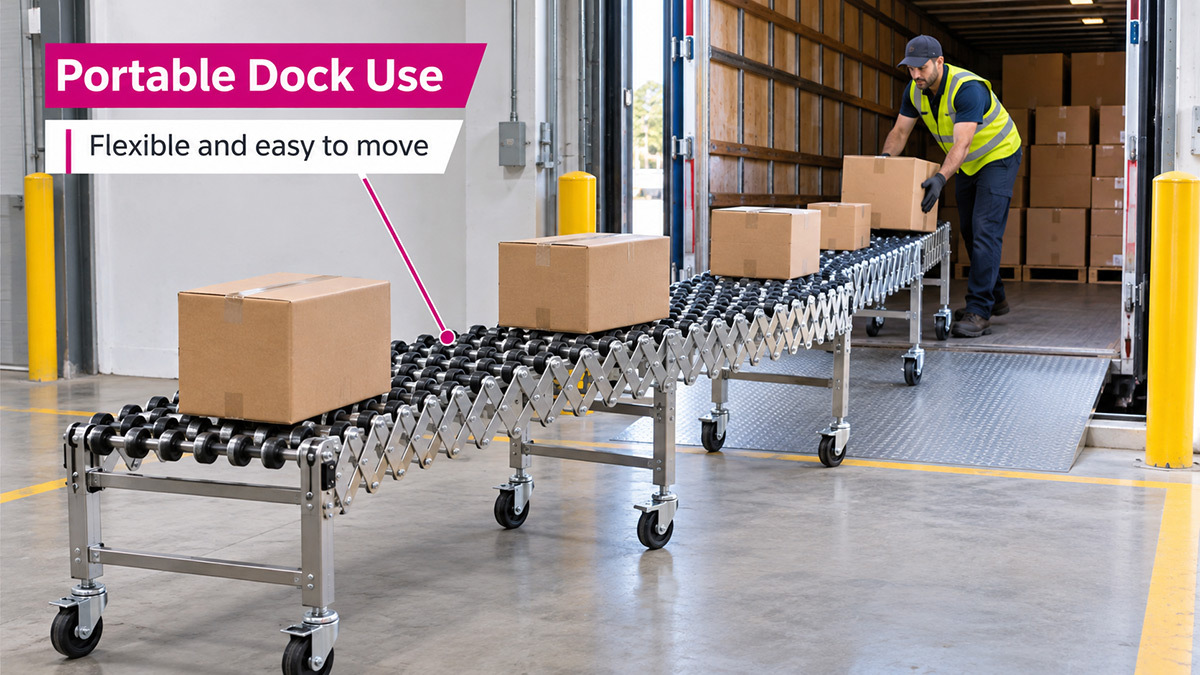
MHI notes that gravity conveyor is the lowest-investment way to support floor-loaded trailers, but it relies on more workers to keep boxes moving, which cuts into its return. Powered rollers and telescoping belt conveyors reduce that labor. If your dock volume is climbing, it is worth comparing gravity against powered roller and belt conveyor before committing.
When to Choose Each Type
|
Choose Gravity Roller When...
|
Choose Skatewheel When...
|
Many facilities use both. Skatewheel handles the dock and temporary runs, while roller takes heavier product and workstation duty. Gravity lines also pair naturally with carton flow rack in picking zones and with pick module systems, where gravity takeaway lanes carry picked cartons toward packing.
Common Gravity Conveyor Specification Mistakes
Try It: Gravity Conveyor Selector and Pitch Estimator
Enter your load details for a first-pass recommendation, the maximum roller spacing, the minimum skatewheel density, and a starting pitch and total drop for your run. Treat the output as a starting point for a field test, not a final specification.
| Load bottom surface | |
| Typical load weight (lb) | |
| Shortest load length in direction of travel (in.) | |
| Gravity run length (ft) | |
| Does the line include curves or spurs? | |
| Does the line need to be portable or temporary? |
Gravity Conveyor as a First Step Toward Automation
Gravity conveyor is often the first piece of material handling automation a growing operation installs, and it rarely goes to waste. Gravity sections are routinely used as takeaway lanes, accumulation buffers ahead of pack stations, and discharge lines off powered conveyor and sorters. Hytrol highlights that gravity conveyors need no motors, which keeps energy use, maintenance, and downtime low, and that they cost less up front than powered systems.
The limitation is control. Gravity lines cannot meter, space, accumulate without pressure, or route product on their own. When throughput, labor availability, or accuracy targets outgrow what a manual gravity line can deliver, that is typically the point to evaluate powered and automated conveyor solutions. If you are weighing that step, our guides on signs your warehouse is ready for automation and building a business case for warehouse automation walk through the numbers.
Budget is another reason gravity makes a smart starting point. Warehouse1 stocks new and used gravity roller and skatewheel conveyor, and buying used can save roughly 30 to 40% on gravity and flex conveyor compared with new. Pairing the right equipment with professional warehouse layout design and installation keeps pitch, heights, and transitions right the first time.
Frequently Asked Questions
Not Sure Which Conveyor Fits Your Flow?
Warehouse1's material handling experts will review your loads, layout, and throughput goals, then recommend the right mix of gravity roller, skatewheel, and powered conveyor, plus a path to automation when you are ready. Schedule a free, no-obligation consultation today.
About Warehouse1
Warehouse1 has been solving material handling and warehouse automation problems since 1988. As a 100% employee-owned company based in Kansas City, Missouri, Warehouse1 acts as a single point of accountability from design through supply and installation — evaluating ASRS, vertical lift modules, robotics, automated conveyor, and pick module systems on their merits, not on which one is easiest to sell. Warehouse1 serves distribution centers, e-commerce, automotive, aerospace, and food and beverage operations, and is a member of the Material Handling Equipment Distributors Association (MHEDA).
| Smarter Solutions, Not Just SKUs. Solutions designed around your operation's actual needs and goals, not a product catalog. | One Partner. End-to-End Execution. From facility assessment and layout design to installation and post-go-live support. |
| Easy to Work With at Every Stage. Simplifying complex projects and reducing operational disruption throughout. | Trusted Expertise. Proven Results. Decades of practical experience across the full range of material handling systems. |
Sources & Further Reading
- MHI Solutions: Conveyor and Sortation Systems Industry Group Future Focused (Dec. 2025)
- MHI: Using Conveyors for Loading and Unloading Trucks and Containers
- MHI Conveyor and Sortation Systems (CSS) Industry Group
- UNEX Manufacturing: When Should I Use Skatewheel Conveyor?
- Mallard Manufacturing: Gravity Conveyor 101, Roller vs. Skate Wheel
- Mallard Manufacturing: Skate Wheel Gravity Conveyor
- Ashland Conveyor: Roller Conveyor vs. Skatewheel Conveyor
- Hytrol: Gravity Roller Conveyor Systems
- Roach Conveyors: 196G Galvanized Roller Gravity Conveyor Specifications
- PackagingConveyor.com: Gravity Roller Conveyors, Angles, Spacing and Selection Guide
- ASME B20.1: Safety Standard for Conveyors and Related Equipment