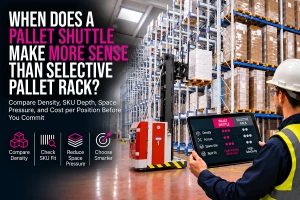
When Does a Pallet Shuttle Make More Sense Than Selective Pallet Rack?
Posted by Warehouse1 on Nov 17th 2026
How to tell when deep-lane shuttle storage beats one-deep racking on density, labor, and cost per pallet position
Selective pallet rack is the default in most warehouses for good reason. Every pallet sits one deep off an aisle, any forklift can reach any load, and the rack is affordable, familiar, and easy to reconfigure. The trade-off is space. In a typical selective layout, more floor goes to forklift aisles than to the rack itself, and once a building fills up, that aisle space becomes the most expensive square footage you have.
A pallet shuttle system attacks that problem directly. Pallets are stored in deep lanes instead of one deep, and a battery-powered shuttle carries each load along rails inside the rack while the forklift waits at the lane entrance. Fewer aisles means more pallets in the same footprint. It also means giving up instant access to every pallet. So the useful question is not which system is better. It is which of your products belong in which system.
This guide covers the factors that decide it: pallets per SKU, space pressure, move patterns, rotation rules, environment, pallet quality, and cost per position. It also includes a layout model and a quick fit check you can run against your own operation.
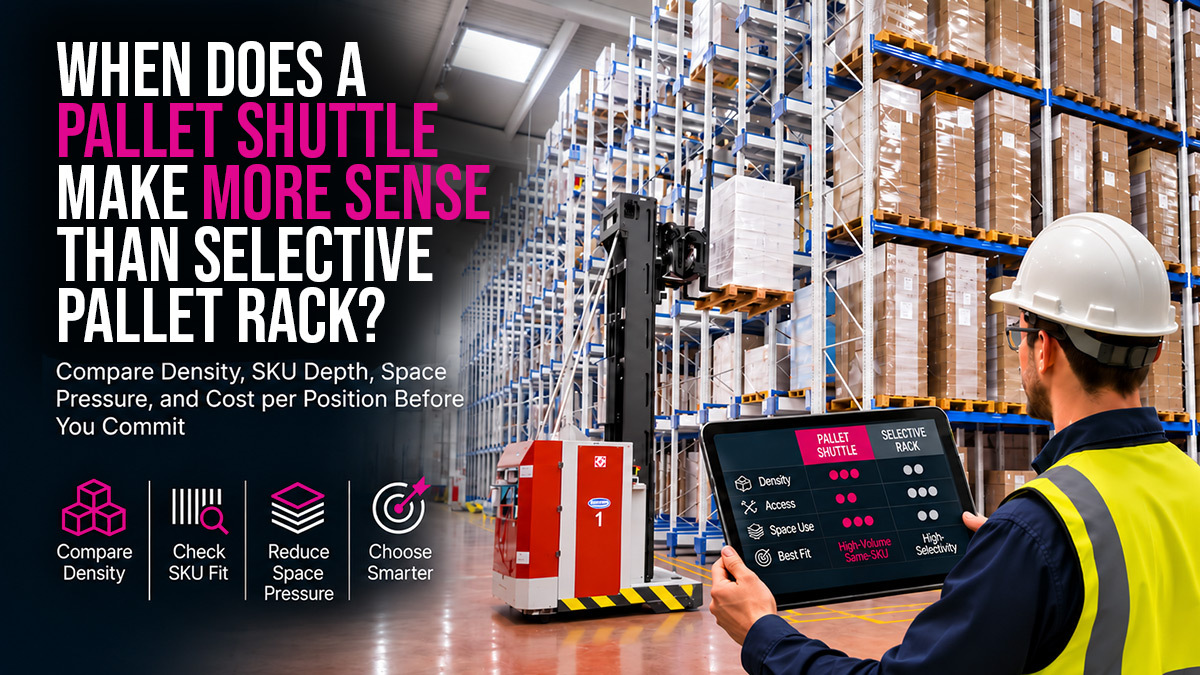
A pallet shuttle makes more sense than selective pallet rack when a meaningful share of your inventory is stored as many pallets of the same SKU, typically 10 or more per item, and floor space is the constraint driving your costs. Because shuttle lanes replace most forklift aisles, a shuttle layout can hold roughly twice the pallet positions of selective rack in the same footprint. Selective rack remains the better choice when you carry many SKUs with only a few pallets each, need direct access to every pallet, or handle mixed pallet types. Most operations get the best result from a hybrid: shuttle lanes for deep, high-volume SKUs and selective rack for everything else.
Warehouse1's experts will model selective, pallet shuttle, and hybrid layouts for your space so you can compare pallet positions side by side. It's free, with no obligation.
Connect with a Storage Solutions Expert Call (888) 558-1830How a Pallet Shuttle Differs From Selective Pallet Rack
Selective rack stores each pallet on beams one position deep, so every load faces an aisle. That is why it offers full selectivity and why it needs so many aisles. For a refresher on rack types and components, see the Warehouse1 pallet racking guide.
A pallet shuttle system uses deep-lane rack with rails instead of beams. A forklift sets the shuttle into a lane and drops pallets at the lane entrance. The operator sends commands by remote, tablet, or warehouse management system, and the shuttle lifts each pallet and carries it to the next open position. Interlake Mecalux lists travel speeds of about 295 ft/min empty and 148 ft/min loaded for its shuttle, with a two-second lift cycle and the ability to fill or empty a whole lane with a single command. Lanes can run far deeper than any forklift could reach: Frazier Industrial's Pallet Mole, for example, works in lanes up to 50 pallet positions deep and six levels high, according to Modern Materials Handling.
Most operations moving up from selective rack start with a semi-automated system, where a forklift moves the shuttle between lanes. Fully automated versions replace that step with transfer cars or stacker cranes, which places them in the family of automated storage and retrieval systems (ASRS). This article focuses on the semi-automated decision.
Selective Pallet Rack vs. Pallet Shuttle at a Glance
| Factor | Selective Pallet Rack | Pallet Shuttle |
|---|---|---|
| How pallets are stored | One deep, every pallet faces an aisle | In deep lanes, several to dozens of pallets per lane |
| Access to each pallet | Direct access to every pallet | Only the pallet at the lane face |
| Best inventory profile | Many SKUs with a few pallets each | Fewer SKUs with many pallets each |
| Floor space in aisles | High: one aisle for every two rows | Low: aisles only at the lane faces |
| Inventory rotation | FIFO by default, any pallet any time | LIFO (wall-backed) or FIFO (aisles at both ends) |
| Forklift travel | Forklift travels to every position | Forklift stops at the lane entrance |
| Upfront cost per position | Lowest of any pallet rack type | Higher: rail rack plus shuttles, batteries, chargers |
| Pallet requirements | Tolerates mixed pallet types | Needs consistent, good-condition pallets |
| Flexibility | Easy to reconfigure, expand, or relocate | Engineered for a set lane depth and load |
The Density Math: Same Footprint, Twice the Pallets
To put numbers on the difference, we modeled a 100 ft by 100 ft storage zone both ways, using the same 40" x 48" pallets, five load levels, and 12 ft counterbalanced forklift aisles. The selective layout fits 10 rows and five aisles for 1,200 pallet positions. Because every pair of rows needs its own aisle, 60% of the floor goes to aisles. The shuttle layout uses a single aisle down the middle with 10-deep lanes on each side for 2,400 positions, and only 12% of the floor is aisle.
Source: Warehouse1 illustrative layout model. Assumptions: 100 ft x 100 ft zone, 40" x 48" pallets, five load levels, 12 ft counterbalanced forklift aisles; selective rack with 96" beams and 42" frames in back-to-back rows; pallet shuttle with 50" lane pitch and 10-deep LIFO lanes. Excludes cross aisles, building columns, code-required flue spaces, and egress paths.
That works out to about 8.3 square feet of floor per pallet position for selective rack and about 4.2 for the shuttle. Real projects rarely land at a clean 2x. Fire protection design may call for flue spaces or in-rack sprinklers in deep lanes, columns interrupt lane runs, and lanes are not always full. On the other side of the ledger, shuttle lanes can run much deeper than 10 positions, which widens the gap. Treat the model as a directional benchmark and confirm it with a layout drawn for your building.
Factor 1: Pallets per SKU Decides Almost Everything
A shuttle lane holds one SKU, or one lot, at a time. If a 10-deep lane holds three pallets, the other seven positions stay locked to that SKU until the lane empties. This is called honeycombing, and it is the fastest way to erase a shuttle's density advantage.
Illustration: Warehouse1. In a LIFO lane, the shuttle compacts pallets toward the back of the lane, so unused positions sit at the face where no other SKU can use them.
As a planning rule of thumb, shuttle storage starts to earn its keep when a SKU regularly holds enough pallets to fill most of a lane, which for common lane depths means roughly 10 or more. The goal is to set lane depth to match your inventory, not to force your inventory into a lane depth. Pull pallets on hand per SKU from your WMS or inventory reports, rank the list, and look at how many pallets sit in your top SKUs. That short list is your shuttle candidate pool. If nearly every SKU holds one to five pallets, a shuttle is the wrong tool, and one of the high-density pallet rack options like double-deep or push-back may be a better step.
Factor 2: What Your Space Is Really Costing You
Density only has value when space is scarce. If you have open floor, selective rack is almost always the least expensive way to add positions. The math changes when the alternative is floor stacking, paying for overflow storage, leasing another building, or expanding. At that point, the right comparison is not shuttle cost versus selective cost. It is the cost of each added pallet position versus the cost of finding that capacity somewhere else. If you are not sure how close to capacity you are, the warehouse space checklist is a useful starting point.
(Shuttle project cost − Selective project cost) ÷ (Shuttle positions − Selective positions)
Compare the result with what one pallet position costs you another way, such as overflow storage, a 3PL, a new lease, or a building expansion, over the payback period you are willing to accept.
Factor 3: How Your Pallets Move
Selective rack is hard to beat for random access. A forklift can go straight to any pallet, which suits operations that pull one pallet each from many different SKUs. Shuttles shine in the opposite pattern: receiving a truckload of one product, building an outbound load of the same item, or feeding a production line from buffer stock. The forklift drops pallets at the lane face, the shuttle handles travel inside the lane, and the driver moves on to other work while the shuttle runs.
The limiting factor in a semi-automated system is moving the shuttle from lane to lane, which takes a forklift trip. A workflow that jumps between many lanes loses much of the gain. Operations that need high pallets-per-hour across many lanes typically look at automated shuttle systems with transfer cars, which Interlake Mecalux positions for applications that must move a high number of pallets per hour.
Where the move pattern fits, the labor savings can be significant. Cold storage provider Merchandise Warehouse added more than 14,000 pallet positions after moving to high-density deep-lane racking with a pallet shuttle system, and its leadership described the labor impact to Modern Materials Handling:
Factor 4: Inventory Rotation Rules
Selective rack gives you FIFO by default because any pallet is reachable at any time. A shuttle system can run either way, and the choice shapes the layout. When lanes back up to a wall and are loaded and unloaded from the same aisle, the system runs last in, first out (LIFO). That gives maximum density and works well for products that are not date sensitive. When lanes sit in an island with aisles at both ends, pallets go in one side and come out the other for true first in, first out (FIFO). The FIFO layout needs a second aisle, but it is still far denser than selective rack. For food, beverage, and other dated products, plan lanes by lot so a single lane never mixes production dates.
Factor 5: Cold Storage and Other High-Cost Environments
Every cubic foot of freezer or cooler space costs money to build and to keep cold, so density is worth more there than in ambient storage. Shuttles also keep lift trucks out of the lanes, which cuts rack impacts in an environment where damage is harder and more expensive to repair. The equipment is built for it. The stow Atlas shuttle, for example, is rated for loads up to 1,500 kg (about 3,300 lb) and operation down to -22°F (-30°C). That is why cold storage and food and beverage warehousing are often where the shuttle case is strongest.
Factor 6: Pallet Quality and Building Readiness
Shuttles ride under pallets inside rails, so pallet condition matters much more than it does in selective rack. Broken bottom boards, overhanging loads, and mixed pallet footprints are common sources of faults and stoppages. Plan for a pallet standard, an inbound inspection step, or slave pallets for problem loads before the system goes live.
The building matters too. Clear height sets the number of levels, column spacing sets lane runs, and the slab has to carry concentrated deep-lane loads. Deep lanes can also change your fire protection design, so bring in your fire protection engineer and local authority having jurisdiction early rather than after the rack is ordered.
When Selective Pallet Rack Is Still the Right Call
A pallet shuttle is not an upgrade for every warehouse. Selective rack usually remains the better choice when:
- Most SKUs hold only one to five pallets at a time.
- You need immediate access to any pallet, as in e-commerce reserve storage, spare parts, or 3PL operations with frequent customer changes.
- Pallet sizes, types, or condition vary widely.
- Space is not yet a constraint, or you are in a short-term lease and may relocate.
- Budget favors the lowest upfront cost. Quality new and used selective pallet rack can stretch a capital budget a long way.
The Hybrid Layout Most Operations End Up With
In practice, the answer is rarely all or nothing. A common approach is to rank SKUs by pallets on hand, put the deep SKUs in a shuttle block near receiving or shipping, and keep selective rack for the long tail of SKUs and for pick locations. The selective rack you move out does not have to go to waste. It can often be redeployed elsewhere in the building through a warehouse reconfiguration, or you can sell your used pallet rack to offset project cost. Warehouse1 designs and supplies both pallet racking systems and shuttle systems, so the layout can be judged on what fits your operation.
If you are weighing a shuttle as a first step into automation, it is also worth reviewing the signs your warehouse is ready for automation.
How to Evaluate a Pallet Shuttle for Your Warehouse
Quick Fit Check: Is a Pallet Shuttle Right for Your Operation?
Answer six questions about the storage zone you are considering. The result points you toward selective rack, a hybrid layout, or a full shuttle evaluation, and flags any issues worth solving first.
Frequently Asked Questions
See Where a Pallet Shuttle Fits in Your Layout
Warehouse1's storage and automation experts will review your pallets per SKU, building constraints, and growth plans, then model selective, pallet shuttle, and hybrid layouts side by side so you can compare positions and cost per pallet before you commit. The consultation is free, with no obligation.
About Warehouse1
Warehouse1 has been solving material handling and warehouse automation problems since 1988. As a 100% employee-owned company based in Kansas City, Missouri, Warehouse1 acts as a single point of accountability from design through supply and installation — evaluating ASRS, vertical lift modules, robotics, automated conveyor, and pick module systems on their merits, not on which one is easiest to sell. Warehouse1 serves distribution centers, e-commerce, automotive, aerospace, and food and beverage operations, and is a member of the Material Handling Equipment Distributors Association (MHEDA).
| Smarter Solutions, Not Just SKUs. Solutions designed around your operation's actual needs and goals, not a product catalog. | One Partner. End-to-End Execution. From facility assessment and layout design to installation and post-go-live support. |
| Easy to Work With at Every Stage. Simplifying complex projects and reducing operational disruption throughout. | Trusted Expertise. Proven Results. Decades of practical experience across the full range of material handling systems. |
Sources & Further Reading
- Roberto Michel, “Next-level cold storage efficiencies,” Modern Materials Handling, March 2021.
- Modern Materials Handling, “Semi-automated, deep-lane racking pallet storage, extraction system.”
- Interlake Mecalux, “Pallet Shuttle” product overview.
- Interlake Mecalux, “Automated Pallet Shuttle” product overview.
- Mecalux, “Pallet Shuttle Racking System” product overview.
- stow Group, “Pallet shuttle system: stow Atlas” product overview.